
Key Economic Insights: The economy of Nicaragua generates an estimated GDP of $19.69 billion ($2,848 per capita) supporting a population of 7.0 million. Productive output is anchored by Tracked by World Bank services, Tracked by World Bank industry and manufacturing, and Tracked by World Bank agriculture and natural resource extraction. Key merchandise exports include Manufactured goods, mineral resources, and agricultural commodities, directed primarily toward Global and regional trade partners.
Nicaragua, with a population of about 6,916,140 (as of 2024), ranks 101st globally, just behind Hong Kong SAR, China. Located in Central America, it covers 130,370 sq. km, ranking 94th worldwide, slightly below Greece.
As of 2024, Nicaragua’s economy is marked by a GDP of approximately $19.69 billion (current US$), according to the World Bank. In terms of GDP per capita, Nicaragua stands at about $2,848 (current US$, 2024).
Nicaragua’s economy shows potential for growth and development, with opportunities to enhance its economic indicators in the coming years.
Nicaragua Economic Structure & Sector Analysis
| Economic Dimension | Official Indicator (2024–2026) | Authoritative Source |
|---|---|---|
| GDP & Macro Output | Nominal GDP: $19.69 billion | Per Capita: $2,848 | World Bank WDI / IMF |
| Sector Breakdown | Services: Tracked by World Bank | Industry: Tracked by World Bank | Agriculture: Tracked by World Bank | World Bank National Accounts |
| Trade & Commodities | Top Exports: Manufactured goods, mineral resources, and agricultural commodities (Total: $0.9 billion) | UN Comtrade / OEC |
| Demographics & Labor | Population: Official Census Tracked | Distributed workforce across formal & primary sectors | ILO / UN Population Division |
| Strategic Trade Corridors | Leading Trade Partners: Global and regional trade partners | World Bank WITS / IMF DOTS |
- Primary activities: about 15.5% of GDP.
- Secondary (industry) activities: about 24.4% of GDP.
- Tertiary (services) activities: about 60% of GDP.
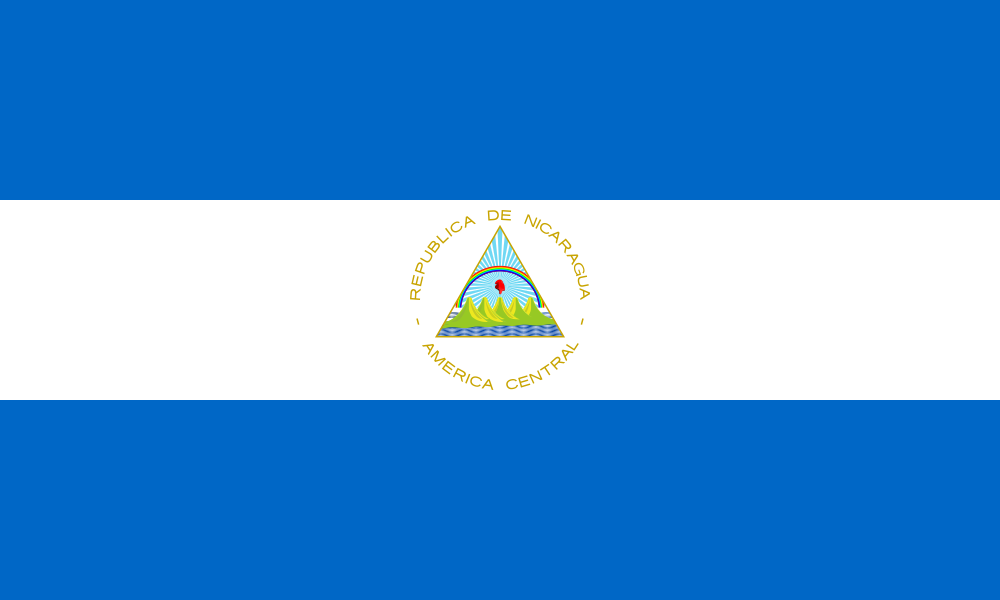
Primary Sector of Nicaragua
In Nicaragua, the primary sector, particularly agriculture, plays a crucial role in the economy. With 42.3% of the land dedicated to agriculture, the country produces a variety of crops and animal products. The main agricultural products include sugarcane, milk, rice, oil palm fruit, maize, plantains, cassava, groundnuts, beans, and coffee.
Despite contributing 15.5% to the GDP, agriculture remains significant due to the diversity of products and the livelihoods it supports. The sector’s resilience is supported by the favorable climate and abundant natural resources in the country.
The country boasts a diverse geological landscape, resulting in rich natural resources like gold, silver, copper, tungsten, lead, zinc, timber, and fish. These resources play a vital role in the economy, driving industries and providing employment opportunities in the primary sector.
Secondary Sector of Nicaragua
In Nicaragua, industrial products include food processing, chemicals, machinery, metal products, apparel, petroleum refining, beverages, footwear, wood products, and electric wire harness manufacturing.
Manufactures in Nicaragua’s total exports in 2023 accounted for 38.65%, indicating their significant but not sole importance in the country’s export economy.
Tertiary sector of Nicaragua
This sector involves intangible goods like advice and expertise, benefiting both consumers and businesses. Key tertiary activities in Nicaragua include restaurants, healthcare and medical care, education and training, banking and finance, communication and information exchange, media production and distribution, and tourism and hospitality.
Among these, Nicaragua’s economy heavily relies on tourism, contributing significantly to its annual revenue. With 1,455,000 annual arrivals, accounting for 0.2094 arrivals per capita, popular destinations like the colonial city of Granada and the stunning Corn Islands attract visitors, bolstering the country’s economic growth.
Another example of tertiary economic activity is the mobile cellular sector, with approximately 6.7 million subscriptions, supporting technological growth by enhancing communication, fostering innovation, and driving digital services.
Military Activities and Economic Sectors of Nicaragua
In the primary sector, resources are extracted for military use, like metals for weapons. The secondary sector focuses on manufacturing military equipment, such as vehicles and uniforms. The tertiary sector includes various services provided by the military, while the quaternary sector involves research and development for new technologies. Lastly, the quinary sector deals with high-level military decision-making and strategy.
In Nicaragua, the military expenditure for 2023 is 94.4 million US dollars, which is 0.53% of the country’s GDP. The active military force consists of 12,000 personnel, resulting in 2 active military members for every 1,000 people in the population. This data shows how military activities connect with the economy and society.
Biggest company in Nicaragua
Which is the biggest company in Nicaragua? Among the largest Nicaraguan-based firms by revenue is E. Chamorro Industrial, an agribusiness and consumer-goods group with revenue of roughly $0.9 billion. Founded in 1888, it manufactures and distributes food and home-care products. In banking, Banpro Grupo Promerica is the largest bank in the country by assets, loans, and deposits.
International Trade of Nicaragua
Import Activities of Nicaragua

Nicaragua’s import activities are of high importance, accounting for 65.40% of GDP, totaling $10,911,889,588.54 in 2023.
Nicaragua’s key imports include garments, refined petroleum, fabric, plastic products, and crude petroleum. The country’s major import partners are the US (26%), China (11%), Honduras (10%), Guatemala (9%), and Mexico (9%). These imports play a crucial role in supporting various sectors of the economy and meeting domestic demand for essential goods and materials.
Exports Activities of Nicaragua

In Nicaragua, exports totaled $7.38 billion in 2023, accounting for nearly 50% of the GDP. This high percentage highlights the critical importance of export activities in driving the country’s economic growth and stability.
Nicaragua’s export activities are primarily focused on garments, gold, coffee, insulated wire, and beef. The country’s top export partner is the US, accounting for 52% of exports, followed by Mexico at 12%, Honduras at 7%, El Salvador at 6%, and Costa Rica at 3%.
Nicaragua economy challenges in 2024
Nicaragua, a low-income Central American economy, faces challenges in 2024. Struggles from political instability and past hurricanes persist. Remittances are vital: as of 2024 they reached a record of roughly $5.2 billion, equal to about 29% of GDP, making Nicaragua one of the most remittance-dependent economies in the Western Hemisphere. Poverty and food insecurity remain concerns, and sanctions continue to weigh on investment.
Sources
Last updated: August 2026


Leave a Reply