
A mixed economy combines private markets with government intervention. Businesses and consumers make most decisions through prices, while the state regulates, provides public services and redistributes income. Almost every country today — from the United States to France — is a mixed economy; they differ only in how large the state’s role is.
What is a mixed economy?
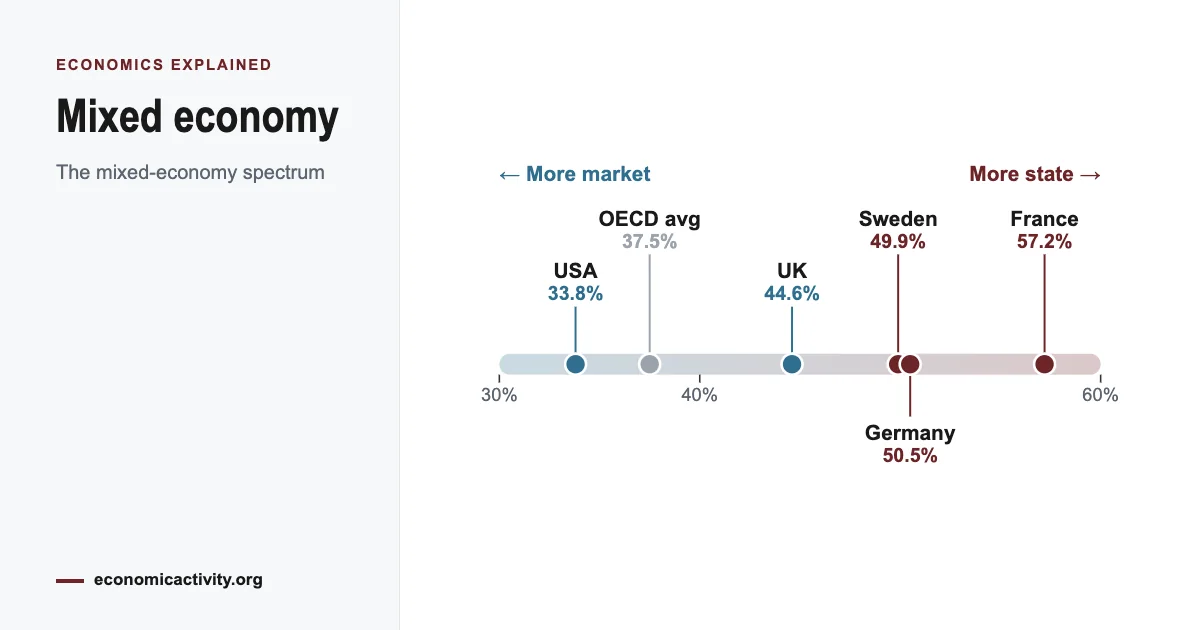
A mixed economy is a market system in which free markets coexist with government intervention (Encyclopaedia Britannica). In practice that describes nearly every modern nation. The gap between them is size of government: total public spending runs to 57.2% of GDP in France but just 33.8% in the United States (Trading Economics, 2025).
It blends the two pure economic systems. Private property and the market answer most of the what-how-for-whom questions, while the state steps in where markets fall short — public goods, regulation and a safety net.

How does a mixed economy work?
In a mixed economy the private sector leads and the public sector corrects. Governments run state-owned enterprises, regulate industry, tax and subsidise, and provide services such as health, education and defence. Across the OECD, general government spending averages 37.5% of GDP (OECD, Government at a Glance 2025).
The state’s footprint varies widely in jobs, too: general government employs close to 30% of all workers in Norway, Sweden and Denmark, but under 10% in Japan and Korea (OECD, 2025). The EU as a whole spent 49.2% of GDP through government in 2024 (Eurostat, 2024) — a reminder that most rich economies cluster near the middle of the spectrum.
Examples of mixed economies
Nearly every country is a mixed economy; what changes is the balance. France sits at the high-intervention end, with government spending at 57.2% of GDP. Sweden pairs a large welfare state with private enterprise. The United States is market-leaning at 33.8%, yet still regulates heavily and runs vast public programmes. Germany and the United Kingdom, near 50% and 45%, fill the middle.
Key takeaways
- A mixed economy blends private markets with government intervention — the norm for modern nations.
- The difference between countries is the size of the state, from ~34% of GDP in the US to ~57% in France.
- Governments regulate, run public services, tax and redistribute alongside private business.
- The OECD average for government spending is 37.5% of GDP (OECD, 2025).
Advantages and disadvantages of a mixed economy
A mixed economy aims for the best of both worlds: market efficiency and innovation, plus a state that supplies public goods, curbs monopolies and cushions inequality. The trade-offs are the cost of that balance — higher taxes, heavier regulation, and constant political argument over where the line between market and state should sit.
Externalities: when the market gets the price wrong
Markets work well when the price of a good reflects all of its costs. Sometimes it does not. A factory that pollutes a river pays for its workers and materials, but not for the damage to fishing, health or tourism downstream. A cost that falls on people outside the trade is called a negative externality, and it is one of the main reasons governments step into the market.
Because the factory ignores the pollution, its costs look lower than the true cost to society. The market therefore produces more of the good than is best: the last units cost society more than they are worth to buyers.
The classic fix is a corrective tax, sometimes called a Pigouvian tax after the economist Arthur Pigou: charge the producer the cost of the damage, and the market will count it. Carbon taxes and fuel duties follow this logic. Other tools are regulation (emission limits), tradable pollution permits, and subsidies for activities with positive externalities, such as vaccination or research. Deciding which market failures to correct, and how, is much of what separates one mixed economy from another.
Concept check
Is the United States a mixed economy?
What are examples of mixed economies?
What is the difference between a mixed economy and a market economy?
Sources
- Encyclopaedia Britannica, Mixed economy — retrieved 2026-07-04 — britannica.com
- Trading Economics, Government spending to GDP (Europe and US) — 2025 — retrieved 2026-07-04 — tradingeconomics.com
- OECD, Government at a Glance 2025 — retrieved 2026-07-04 — oecd.org
- Eurostat, Government finance statistics, 2024 — retrieved 2026-07-04 — ec.europa.eu
Last updated: October 22, 2026

Leave a Reply