
Key Economic Insights: The economy of Turks and Caicos Islands generates an estimated GDP of $1.75 billion ($37,507 per capita) supporting a population of 46,000. Productive output is anchored by 90.6% services, 8.9% industry and manufacturing, and 0.5% agriculture and natural resource extraction. Key merchandise exports include Manufactured goods, mineral resources, and agricultural commodities, directed primarily toward Global and regional trade partners.
Turks and Caicos Islands, with a population of about 46,535 (2024), is one of the smallest jurisdictions in the Caribbean. Located in the Caribbean, it covers 950 sq. km of land area.
As of 2024, the Turks and Caicos Islands had a GDP of about $1.75 billion, according to the World Bank. In terms of GDP per capita, the territory recorded roughly $37,507 in 2024, reflecting one of the higher income levels in the Caribbean.
Despite its small size, the Turks and Caicos Islands maintain a stable economic position, with a focus on tourism and financial services driving its economy.
Turks and Caicos Islands Economic Structure & Sector Analysis
| Economic Dimension | Official Indicator (2024–2026) | Authoritative Source |
|---|---|---|
| GDP & Macro Output | Nominal GDP: $1.75 billion | Per Capita: $37,507 | World Bank WDI / IMF |
| Sector Breakdown | Services: 90.6% | Industry: 8.9% | Agriculture: 0.5% | World Bank National Accounts |
| Trade & Commodities | Top Exports: Manufactured goods, mineral resources, and agricultural commodities (Total: $442 million) | UN Comtrade / OEC |
| Demographics & Labor | Population: Official Census Tracked | Distributed workforce across formal & primary sectors | ILO / UN Population Division |
| Strategic Trade Corridors | Leading Trade Partners: Global and regional trade partners | World Bank WITS / IMF DOTS |
- Primary activities: 0.5% of GDP (2017 est.).
- Secondary activities: 8.9% of GDP (2017 est.).
- Tertiary activities: 90.6% of GDP (2017 est.).
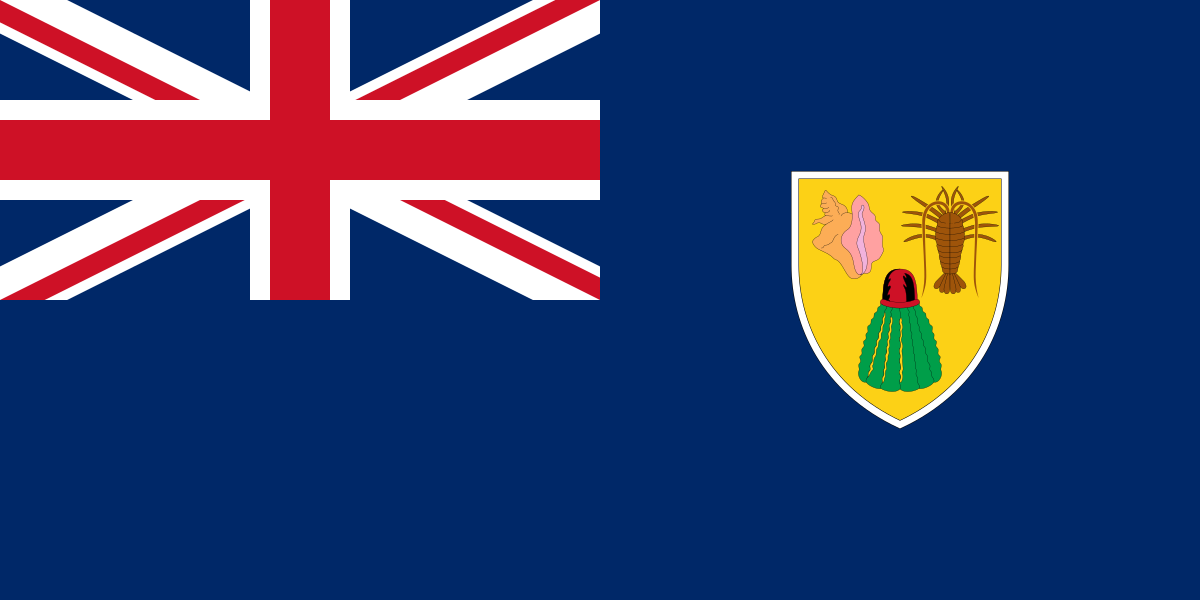
Primary Sector of Turks and Caicos Islands
The primary sector in Turks and Caicos Islands is predominantly focused on agriculture, despite its small contribution to the GDP. The country’s agricultural land occupies 1.05% of its territory, with main products including corn, beans, cassava, citrus fruits, and fish.
The favorable climate and rich natural resources support the cultivation of a variety of crops and animal products. Agriculture, forestry, and fishing collectively contribute 0.5% to the GDP, highlighting the sector’s significance in providing food security and supporting local livelihoods.
The primary sector thrives on the abundance of spiny lobster and conch, driving economic growth through fishing and exports.
Secondary Sector of Turks and Caicos Islands
In Turks and Caicos Islands, the main industrial product is construction. This sector plays a crucial role in the economy by creating infrastructure for development and supporting the tourism industry.
In 2023, manufactures in the total exports of the Turks and Caicos Islands are not significant, comprising only a small percentage. The country’s economy relies more heavily on other sectors for its export revenue.
Tertiary sector of Turks and Caicos Islands
The tertiary sector in the Turks and Caicos Islands involves providing intangible services to enhance productivity and meet needs. Main activities include restaurants, healthcare, education, banking, communication, tourism, and transportation.
Specifically, Tourism is a vital economic sector for the Turks and Caicos Islands. As of 2024, the islands welcomed a record 1,959,563 visitor arrivals (734,308 by air and 1,225,255 cruise passengers), far exceeding the resident population. Grace Bay Beach and Chalk Sound National Park are among the most popular destinations, renowned for their pristine waters and natural beauty, attracting visitors worldwide.
Another example of tertiary economic activity is the mobile cellular sector, which boasts over 25,000 subscriptions, equating to 110 per 100 inhabitants. This connectivity fosters technological growth, enhancing communication and innovation.
International Trade of Turks and Caicos Islands
Import Activities of Turks and Caicos Islands

The import activities of the Turks and Caicos Islands are crucial, accounting for 38.81% of GDP in 2023, totaling $442 million.
The Turks and Caicos Islands rely heavily on imports, with the US being the main partner at 75%. Imports include refined petroleum, cars, plastic products, furniture, and aluminum structures from various countries such as the Dominican Republic, Italy, Switzerland, and China.
Exports Activities of Turks and Caicos Islands

The export activities of the Turks and Caicos Islands are of low importance, accounting for only 3.64% of GDP in 2023, totaling $41.4 million. This indicates a limited reliance on exports for economic growth and highlights the need for diversification to enhance the country’s economic stability.
The Turks and Caicos Islands primarily export fish and shellfish (notably spiny lobster and conch), spirits, and re-exported goods. Their leading export destination is the United States, followed by Spain and a small number of other markets.
Turks and Caicos Islands economy challenges in 2024
In 2024, Turks and Caicos Islands continue to face challenges post-COVID-19. The economy, heavily reliant on tourism, struggles. Biodiversity is at risk, unemployment is rising, and the trade balance remains negative. The country’s dependency on fossil fuels adds to its woes.
Sources
- World Bank: Turks and Caicos Islands
- CIA World Factbook: Turks and Caicos Islands
- Observatory of Economic Complexity: Turks and Caicos Islands trade
- UN Comtrade Plus: Trade Flow
Last updated: August 2026


Leave a Reply