
Gross Domestic Product (GDP) is the total market value of all final goods and services produced inside a country over a period, usually a year. It is the single most-used measure of the size of an economy. World GDP reached about $111 trillion in 2024 (World Bank). GDP is most often calculated as C + I + G + net exports.
What is GDP?
GDP is the total market value of all final goods and services produced within a country in a given period (US Bureau of Economic Analysis). It is the headline number for the size of an economy: add up everything a nation makes and sells, and you get its GDP. Worldwide, that total was roughly $111 trillion in 2024 (World Bank, 2024).
Because it captures the value of everything produced, GDP is how we compare economies, track recessions and measure growth. It answers a simple question for every economic activity in a country: what is it all worth?
How is GDP calculated?
The most common method is the expenditure approach, which adds up all spending in the economy. The US Bureau of Economic Analysis writes it as GDP = C + I + G + (X − M) (BEA, 2025):
- C = consumption: what households spend on goods and services.
- I = investment: business spending on equipment, buildings and inventory.
- G = government spending on goods and services.
- X − M = net exports: exports minus imports (also written as NX).
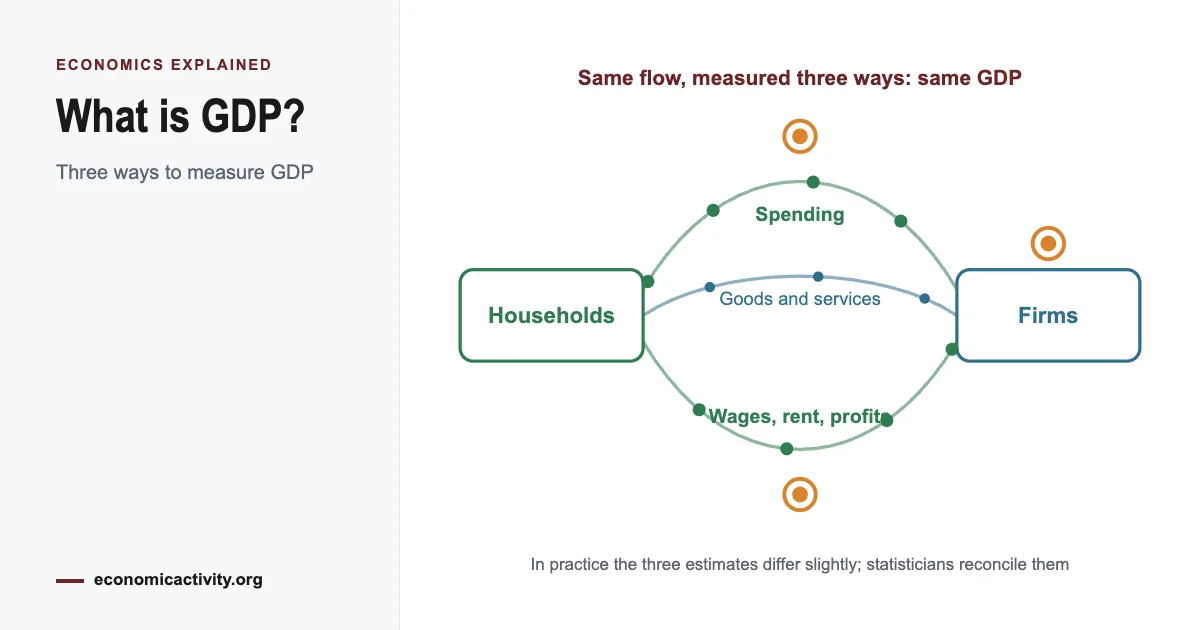
Economists also calculate GDP two other ways: by adding up all incomes, or all value added in production. In principle, all three give the same total.
Why do the three methods agree? Because they measure the same circular flow at three different points.
Nominal GDP vs real GDP
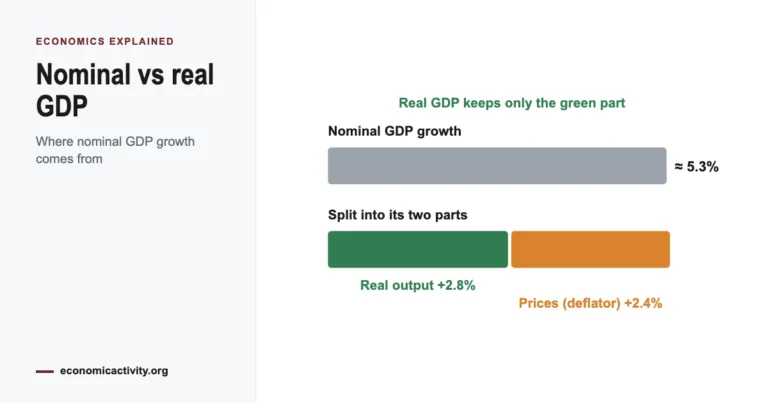
Nominal GDP measures output at current prices, so it rises when prices rise. Real GDP strips out inflation to show the true change in the quantity of goods and services produced. When news reports say an economy grew by a certain percentage, they almost always mean real GDP. The IMF expects world growth of about 3.1% in 2026 (IMF, October 2026).
Which countries have the largest GDP?
The United States is the world’s largest economy, with nominal GDP of about $32.6 trillion in 2026, ahead of China at roughly $21.5 trillion (IMF, October 2026). Germany, Japan and the United Kingdom follow, with India close behind in sixth. Together, the top economies produce a large share of world output, which the IMF puts at about $128 trillion in 2026.
Key takeaways
- GDP is the total market value of all final goods and services produced in a country.
- It is usually calculated as C + I + G + net exports (BEA).
- Real GDP adjusts for inflation; nominal GDP does not.
- The US (~$32.6T) and China (~$21.5T) are the two largest economies (IMF, October 2026).
Why GDP matters — and its limits
GDP drives huge decisions: central banks, investors and governments all watch it to judge whether an economy is expanding or shrinking. But it is not a measure of well-being. GDP ignores unpaid work, income inequality, environmental damage and whether growth improves people’s lives. It tells you the size of the pie, not how it is shared.
Total GDP vs GDP per person: big economy, rich people?
GDP measures the size of an economy, not how well off its people are. A country can have a huge GDP simply because it has a huge population. To compare living standards, economists divide GDP by the number of people to get GDP per person, also called GDP per capita.
That one step changes the ranking completely. In 2025 China had the world’s second-largest economy, at about $19.5 trillion, and India the sixth-largest, at about $4.0 trillion (World Bank). But each has around 1.4 billion people, so output per person is far lower: about $13,862 in China and $2,702 in India, compared with about $90,027 in the United States.
Neither number is the “right” one; they answer different questions. Total GDP tells you an economy’s weight in the world: how big a market it offers, how much it can spend on defence, how much it matters for global growth. GDP per person comes closer to the living standard of a typical resident, although it is still an average that ignores how income is shared. To compare living standards across countries, economists also adjust GDP per person for differences in prices, using purchasing power parity, which narrows the gap between rich and poor countries.
Concept check
How is GDP calculated?
What is the difference between nominal and real GDP?
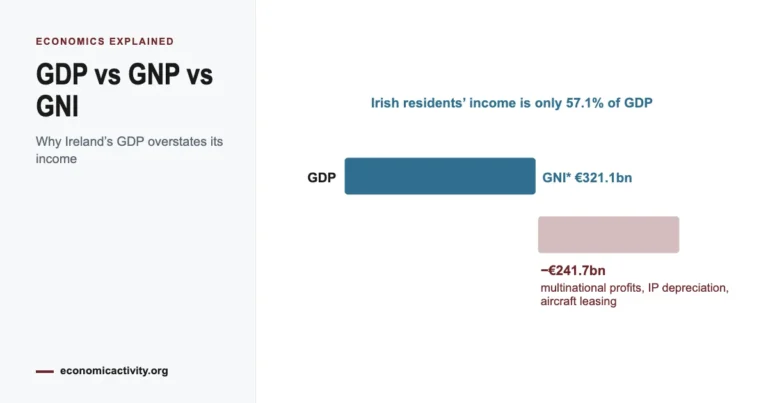
What is the difference between GDP and GNP?
Is GDP a good measure of a country’s well-being?
Sources
- US Bureau of Economic Analysis, The Expenditures Approach to Measuring GDP, 2025 — retrieved 2026-07-04 — bea.gov
- World Bank, GDP (current US$), World, 2024 — retrieved 2026-07-04 — data.worldbank.org
- IMF, World Economic Outlook, October 2026 — retrieved 2026-10-22 — imf.org
- Encyclopaedia Britannica, Gross domestic product — retrieved 2026-07-04 — britannica.com
Last updated: October 2026

Leave a Reply