BRICS stands for Brazil, Russia, India, China and South Africa, an economic bloc of major emerging economies. After a 2024–2025 expansion it now has about 10 members, including Egypt, Ethiopia, Iran, the UAE and Indonesia. Together the group produces well over a third of world GDP in purchasing-power terms.
What are the BRICS countries?
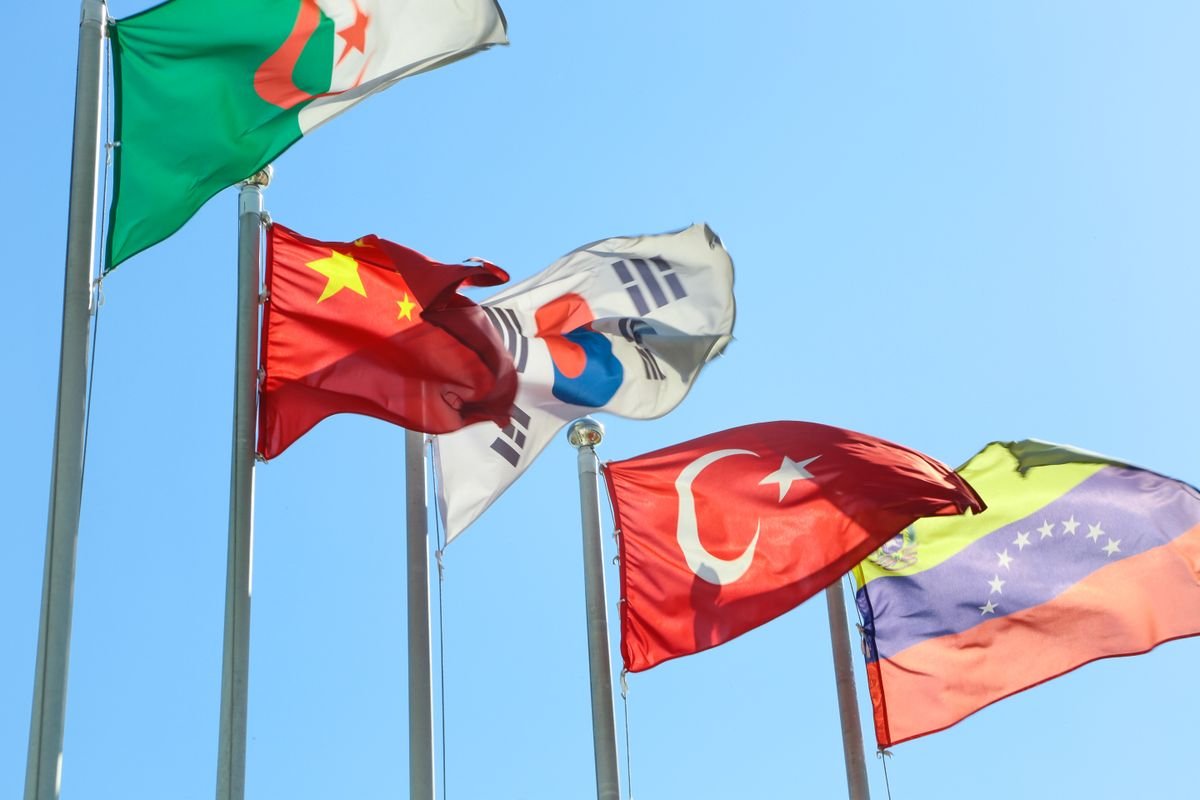
BRICS is a group of major emerging economies that coordinate on trade, finance and geopolitics as a counterweight to the Western-led G7. The name comes from the initials of the founding members. The bloc formed as “BRIC” in 2009, added South Africa in 2010 to become BRICS, and expanded again in 2024 and 2025.
| Member | Joined |
|---|---|
| Brazil | 2009 (founding) |
| Russia | 2009 (founding) |
| India | 2009 (founding) |
| China | 2009 (founding) |
| South Africa | 2010 |
| Egypt | 2024 |
| Ethiopia | 2024 |
| Iran | 2024 |
| United Arab Emirates | 2024 |
| Indonesia | 2025 |
| Saudi Arabia | Invited — status not yet confirmed |
Saudi Arabia was invited in 2023 but has not formally confirmed membership; sources differ on whether to count it. Argentina was invited and declined. A separate group of “partner countries” is not counted as full members.
How big is the BRICS economy?
The expanded bloc is an economic heavyweight. On a purchasing-power basis, BRICS+ accounts for about 36.7% of world GDP, ahead of the G7’s 29.6% (EY, using IMF data, 2024). The members also represent close to half of the world’s population, giving the group weight far beyond its share of global financial markets.
Key takeaways
- BRICS = Brazil, Russia, India, China, South Africa, plus 2024/2025 joiners.
- The bloc has about 10 confirmed members; Saudi Arabia’s status remains unconfirmed.
- BRICS+ produces ~36.7% of world GDP (PPP), ahead of the G7’s 29.6% (EY/IMF, 2024).
- It runs the New Development Bank but has no common currency.
What does BRICS do?
BRICS holds annual summits and coordinates positions on trade, development and reform of global institutions. Its main concrete creation is the New Development Bank, established in 2015 and headquartered in Shanghai, with $100 billion of authorised capital to fund infrastructure and development projects (New Development Bank). Despite frequent speculation, the group has no shared currency, though members discuss trading more in their own currencies.
BRICS vs the G7: the shift in economic weight
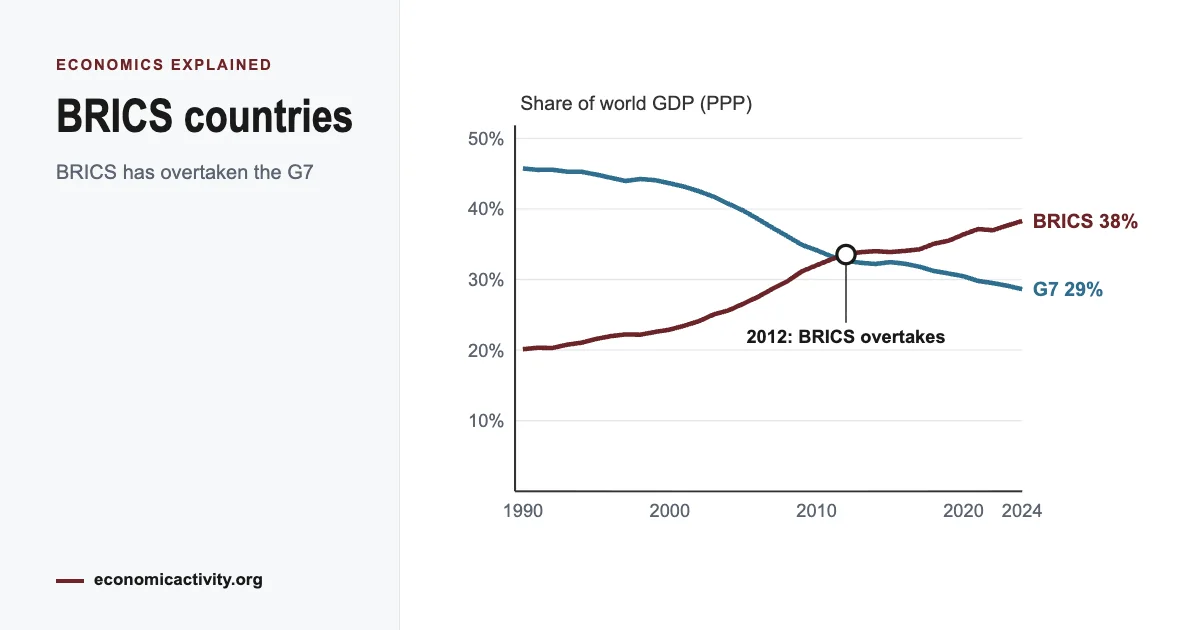
The case for BRICS as an economic bloc rests on one long-running trend: emerging economies have been growing faster than the old industrial powers for decades. Measured at purchasing power parity, which adjusts for lower prices in poorer countries, the ten current BRICS members produced about 20% of world GDP in 1990. By 2024 their share had risen to about 38%, while the G7’s fell from 46% to 29% (World Bank).
On these figures, the combined output of today’s BRICS members overtook the G7 around 2012. China accounts for most of the rise, followed by India.
The picture looks different at market exchange rates, where the G7 is still larger because prices in rich countries are higher. Both views are useful: PPP shows how much the economies produce, while market rates show their buying power in world markets, which matters for trade, finance and investment. Economic size also does not make BRICS a unified bloc: its members have very different economies and often different political goals.
Concept check
How many countries are in BRICS in 2026?
Is Saudi Arabia in BRICS?
Does BRICS have its own currency?
Sources
- Government of Brazil (Planalto), Indonesia becomes full BRICS member, Jan 2025 — retrieved 2026-07-04 — gov.br
- New Development Bank, About NDB — retrieved 2026-07-04 — ndb.int
- EY, BRICS and global economic policy (IMF data) — retrieved 2026-07-04 — ey.com
- Encyclopaedia Britannica, BRICS — retrieved 2026-07-04 — britannica.com
Last updated: October 22, 2026

Leave a Reply