
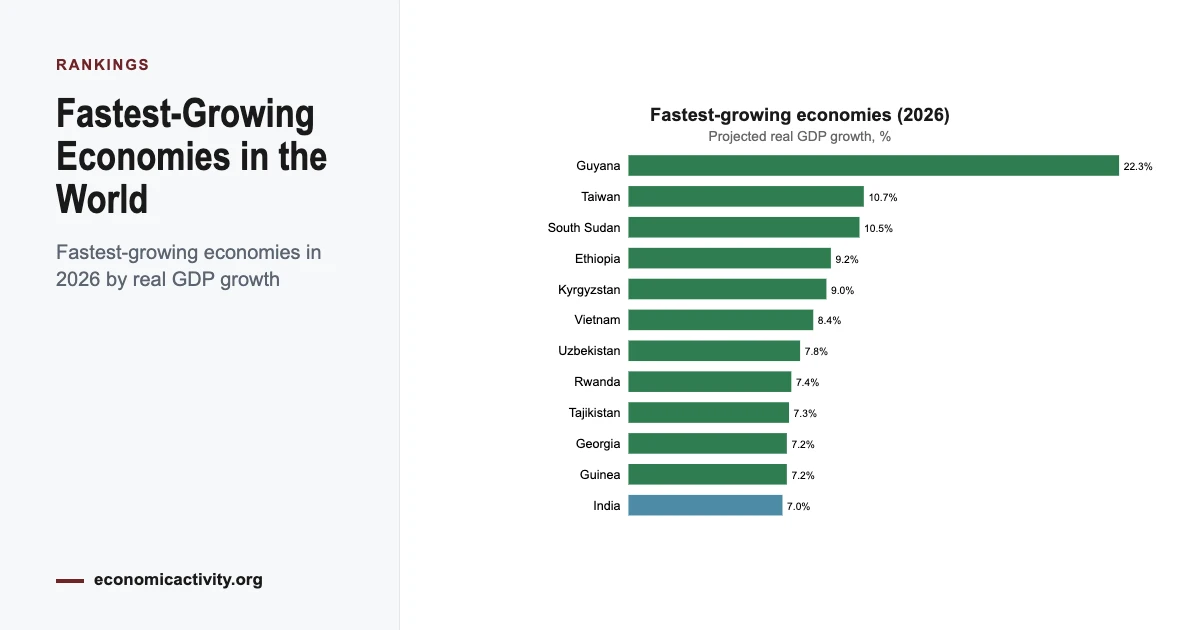
Guyana is the world’s fastest-growing economy, with real GDP projected to expand about 22% in 2026 as its oil output keeps rising (IMF, October 2026). Taiwan, South Sudan and Ethiopia follow, Asian and African economies fill most of the rest of the list, and India is the fastest-growing major economy at about 7%.
The fastest-growing economies in the world (2026)
Ranked by projected real GDP growth for 2026, the leaders are a mix of resource producers, fast-industrialising Asian economies and reforming African economies. Guyana stands far ahead at about 22%, while the global economy is expected to grow just 3.1% (IMF World Economic Outlook, October 2026).
| Rank | Country | Projected 2026 real GDP growth |
|---|---|---|
| 1 | Guyana | 22.3% |
| 2 | Taiwan | 10.7% |
| 3 | South Sudan | 10.5% |
| 4 | Ethiopia | 9.2% |
| 5 | Kyrgyzstan | 9.0% |
| 6 | Vietnam | 8.4% |
| 7 | Uzbekistan | 7.8% |
| 8 | Rwanda | 7.4% |
| 9 | Tajikistan | 7.3% |
| 10 | Georgia | 7.2% |
| 11 | Guinea | 7.2% |
| 12 (tied) | Benin, Bhutan, India, Niger, Sudan | 7.0% |
Source: IMF World Economic Outlook (October 2026), 2026 real GDP growth projections. Guyana’s figure revises heavily between editions, and the figures for South Sudan and Sudan are rebounds from deep, conflict-related contractions and are highly uncertain.
Why these economies are booming
Several forces stand out. New natural-resource wealth is transforming small economies: Guyana’s offshore oil has produced the fastest growth on Earth, and Guinea and Niger are riding demand for mining. In Asia, Taiwan is growing on exports of advanced semiconductors and Vietnam on export manufacturing, while Central Asian economies such as Kyrgyzstan, Uzbekistan and Tajikistan are among the fastest growers. Elsewhere, structural reform and infrastructure drive the gains: Ethiopia, Rwanda and Benin are growing without a resource windfall. Sub-Saharan Africa as a whole is projected to grow about 4.5% in 2026, well above the world average (IMF). India, meanwhile, remains the fastest-growing major economy at about 7%.

Key takeaways
- Guyana is the world’s fastest-growing economy at about 22% in 2026, driven by oil (IMF).
- Taiwan, South Sudan and Ethiopia follow; Asian and African economies fill most of the rest of the list.
- India is the fastest-growing major economy at about 7%.
- The world economy is projected to grow just 3.1% in 2026 (IMF).
Fast growth is not the same as being rich
A high growth rate measures how fast an economy is expanding, not how wealthy it already is. Many countries on this list start from a low base, so rapid percentage growth still leaves them with modest incomes per person. Guyana is the exception: its oil boom has pushed output per head to genuinely high levels. But for most, fast growth is the beginning of catch-up, not proof of prosperity.
Economists explain why fast growth and low income so often go together with the idea of catch-up growth.
Frequently asked questions
Which is the fastest-growing economy in the world?
Guyana, with real GDP projected to grow about 22% in 2026 (IMF). Its oil discoveries, spread across a very small population, have produced the fastest economic growth of any country for several years running.
Which is the fastest-growing major economy?
India, at about 7% projected growth for 2026 (IMF), is the fastest-growing large economy, well ahead of China and the advanced economies, which are expected to grow far more slowly.
Why is Africa growing so fast?
A young population, natural resources and economic reforms are lifting growth in sub-Saharan Africa to about 4.5% in 2026 (IMF). East Africa, including Ethiopia, Rwanda and Uganda, is the fastest-growing part of the continent.
Sources
- IMF, World Economic Outlook, October 2026 — retrieved 2026-10-22 — imf.org
- African Development Bank, African Economic Outlook 2026 — retrieved 2026-07-04 — afdb.org
- World Bank, GDP growth (annual %) — retrieved 2026-07-04 — data.worldbank.org
Last updated: October 2026

Leave a Reply