
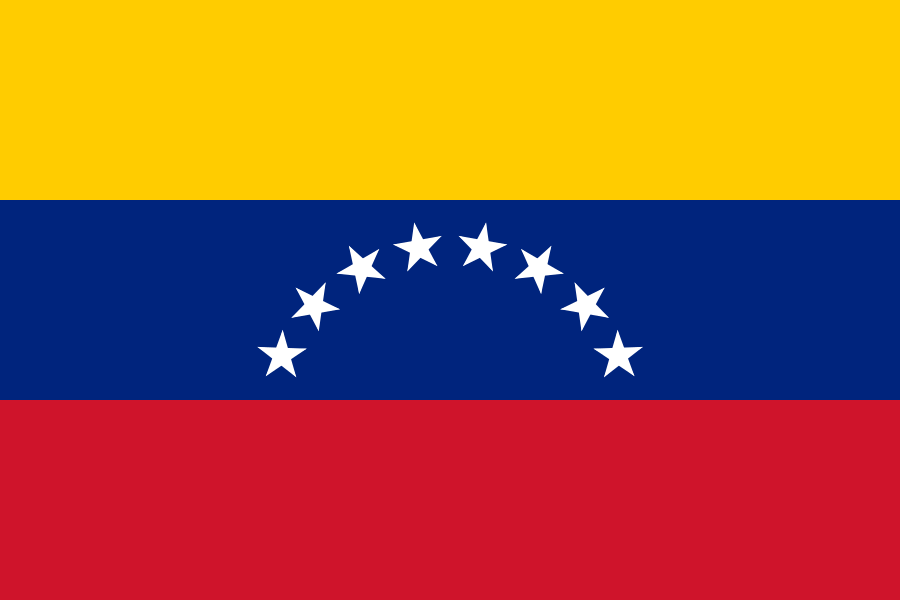
Key Economic Insights: The economy of Venezuela generates an estimated GDP of $119.8 billion ($3,740 per capita) supporting a population of 28.8 million. Productive output is anchored by 54.9% services, 40.4% industry and manufacturing, and 4.7% agriculture and natural resource extraction. Key merchandise exports include Manufactured goods, mineral resources, and agricultural commodities, directed primarily toward Global and regional trade partners.
Venezuela’s economic position reflects a challenging landscape. As of 2024, its GDP was approximately $119.8 billion (World Bank estimate), up from about $102.4 billion in 2023 as oil output partly recovered. As of 2025, GDP per capita was estimated at roughly $3,740 (IMF). Because of severe inflation and currency depreciation, figures for Venezuela are estimates and are revised frequently.
Despite its vast natural resources, Venezuela faces economic instability due to political turmoil and declining oil production, impacting its overall economic performance. Efforts to diversify the economy and address structural issues are crucial for Venezuela to improve its economic standing and foster sustainable growth.
Venezuela Economic Structure & Sector Analysis
| Economic Dimension | Official Indicator (2024–2026) | Authoritative Source |
|---|---|---|
| GDP & Macro Output | Nominal GDP: $119.8 billion | Per Capita: $3,740 | World Bank WDI / IMF |
| Sector Breakdown | Services: 54.9% | Industry: 40.4% | Agriculture: 4.7% | World Bank National Accounts |
| Trade & Commodities | Top Exports: Manufactured goods, mineral resources, and agricultural commodities (Total: $3.9 million) | UN Comtrade / OEC |
| Demographics & Labor | Population: 28 | Distributed workforce across formal & primary sectors | ILO / UN Population Division |
| Strategic Trade Corridors | Leading Trade Partners: Global and regional trade partners | World Bank WITS / IMF DOTS |
- Primary activities: 4.7% of GDP.
- Secondary activities: 40.4% of GDP.
- Tertiary activities: 54.9% of GDP.
Primary Sector of Venezuela
With 24.37503543% of its land dedicated to agriculture, the country produces a variety of crops and animal products. Some of its main agricultural products include milk, sugarcane, maize, plantains, oil palm fruit, bananas, rice, potatoes, and pineapples.
Despite agriculture contributing 4.7% to the GDP, the sector plays a crucial role in providing food security and employment. The wide range of products showcases the sector’s significance in sustaining the country’s agricultural economy.
With its diverse geology, the primary sector thrives on abundant natural resources like petroleum, natural gas, iron ore, gold, bauxite, and other minerals. Hydropower and diamonds further bolster the economy.Venezuela’s gas production of 26,000 million m³ in 2020 secures its position as the 29th largest natural gas producer globally.Secondary Sector of Venezuela
In Venezuela, the main industrial products include machinery, transport equipment, construction materials, medical equipment, pharmaceuticals, chemicals, iron and steel products, crude oil, and petroleum products.Manufactures play a crucial role in Venezuela’s total exports, accounting for a significant 85.83% in 2023. This highlights the importance of the manufacturing sector in driving the country’s economy and international trade.Tertiary sector of Venezuela

Military Activities and Economic Sectors of Venezuela
In the primary sector, resources are extracted for military use, like oil and minerals. The secondary sector includes the manufacturing of military equipment, such as weapons and vehicles. The tertiary sector involves services provided by the military, while the quaternary sector focuses on military research and development. The quinary sector deals with high-level decision-making and strategy within the military.
In Venezuela, the military expenditure for 2023 is $3.9 million. This spending is about 0.65% of the country’s GDP. The active military force consists of 123,000 personnel, which means there are about 11.1 active military members for every 1,000 people in the country.
International Trade of Venezuela
Import Activities of Venezuela
 Venezuela’s import activities are of high importance, accounting for 10.40% of its GDP in 2023, totaling $9.59 billion.Venezuela’s key import activities include sourcing soybean oil, wheat, soybean meal, corn, and plastic products. Its major import partners are China (31%), US (23%), Brazil (14%), Colombia (7%), and Turkey (4%).
Exports Activities of Venezuela
 Venezuela’s total exports in 2023 were $4.3 billion, accounting for 4.66% of its GDP. With a low importance level, export activities play a minor role in the country’s economy.Venezuela’s export activities are diverse, with top partners being China, Turkey, Spain, US, and Brazil. Key exports include scrap iron, petroleum coke, crude petroleum, acyclic alcohols, and aluminum.
Venezuela economy challenges in 2024
In 2024, Venezuela continues to struggle with a chaotic economy plagued by hyperinflation and political corruption. Infrastructure cuts and human rights abuses add to the challenges. The country is in debt default despite being an oil exporter and hydropower consumer. Relations with China are on the rise, but internal issues remain a significant hurdle.Sources
- World Bank: Venezuela
- IMF Data Mapper: Venezuela
- CIA World Factbook: Venezuela
- Our World in Data: Human Development Index
- UN Comtrade Plus: Trade Flow
- SIPRI Military Expenditure Database
Last updated: August 2026



Leave a Reply