
Key Economic Insights: The economy of Spain generates an estimated GDP of $1.73 trillion ($35,327 per capita) supporting a population of 48,848,840. Productive output is anchored by 74.2% services, 23.2% industry and manufacturing, and 2.6% agriculture and natural resource extraction. Key merchandise exports include Manufactured goods, mineral resources, and agricultural commodities, directed primarily toward Global and regional trade partners.
As of 2024, Spain’s economic position is robust, with a GDP of about $1.73 trillion (current US$), ranking among the world’s 15 largest economies. In terms of GDP per capita, Spain stands at about $35,327 (current US$, 2024). [World Bank]
Spain’s economy is diverse, with key industries including tourism, automotive, and agriculture contributing significantly to its GDP. The country’s economic stability and strategic investments continue to drive growth and attract foreign investment.
Spain Economic Structure & Sector Analysis
| Economic Dimension | Official Indicator (2024–2026) | Authoritative Source |
|---|---|---|
| GDP & Macro Output | Nominal GDP: $1.73 trillion | Per Capita: $35,327 | World Bank WDI / IMF |
| Sector Breakdown | Services: 74.2% | Industry: 23.2% | Agriculture: 2.6% | World Bank National Accounts |
| Trade & Commodities | Top Exports: Manufactured goods, mineral resources, and agricultural commodities (Total: Official UN Comtrade) | UN Comtrade / OEC |
| Demographics & Labor | Population: 48,848,840 | Distributed workforce across formal & primary sectors | ILO / UN Population Division |
| Strategic Trade Corridors | Leading Trade Partners: Global and regional trade partners | World Bank WITS / IMF DOTS |
- Primary activities: 2.6% of GDP.
- Secondary activities: 23.2% of GDP.
- Tertiary activities: 74.2% of GDP.
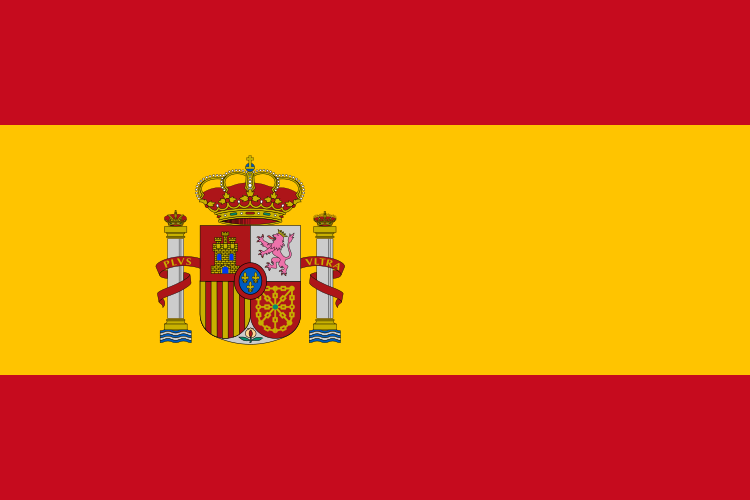
Primary Sector of Spain
With 52.48% of the land dedicated to agriculture, the country produces a variety of crops and animal products. The main agricultural products include milk, barley, wheat, grapes, pork, olives, tomatoes, maize, oranges, and sugar beets.
Despite contributing only 2.6% to the GDP, agriculture plays a vital role in providing employment and sustaining rural communities. The country’s agricultural sector benefits from its rich soil and favorable climate, ensuring a steady production of a wide range of high-quality agricultural products.
The country’s diverse geology provides a rich array of natural resources, including coal, iron ore, copper, and lead. These resources play a crucial role in the economy, supporting industries such as mining, manufacturing, and energy production. Additionally, the presence of hydropower resources and vast arable land further contributes to the country’s economic development and sustainability.Despite its limited oil production of around 131 barrels per day, Spain ranks 75th in the world. With oil reserves of 150 million barrels, accounting for only 0.01% of global reserves, the country’s oil economic activity is relatively small compared to its other natural resources.Spain’s natural gas production in 2020 reached 62 million m³, ranking 85th globally. This production significantly contributes to the country’s energy sector, supporting economic growth and sustainability.Secondary Sector of Spain
In Spain, the main industrial products include textiles, food, metals, chemicals, automobiles, shipbuilding, pharmaceuticals, and medical equipment.Manufactures play a crucial role in Spain’s total exports, accounting for 65.71% in 2023. They drive economic growth, create jobs, and contribute significantly to the country’s trade balance.Tertiary sector of Spain

Military Activities and Economic Sectors of Spain
In the primary sector, resources are extracted for military use, like metals for weapons. The secondary sector includes the manufacturing of military equipment, which creates jobs and boosts the economy. The tertiary sector involves services provided by the military, such as training and logistics. The quaternary sector focuses on research and development, while the quinary sector deals with high-level military decisions and strategies.
In Spain, the military expenditure for 2023 is about 23,699.1 million US dollars, which is 1.46% of the country’s GDP. Spain has an active military force of 120,350 personnel. This means there are about 4.4 active military members for every 1,000 people in the country.
Biggest company in Spain
Which is the biggest company in Spain? The largest company is Inditex (the textile group behind Zara), with a market value of about 199 billion USD as of 2026. It operates in the retail/fashion industry and is a major player in Spain’s tertiary economic sector. [Market cap data]International Trade of Spain
Import Activities of Spain
 Spain heavily relies on imports, accounting for 39.66% of its GDP in 2023, highlighting the significant role import activities play in the country’s economy.Spain’s import activities are diverse, with key partners like Germany, China, France, Italy, and the US. Imports include crude petroleum, natural gas, garments, cars, and vehicle parts/accessories.
Exports Activities of Spain
 In Spain, export activities play a highly important role, accounting for over 40% of the GDP in 2023, totaling 420 billion euros. This demonstrates a significant reliance on international trade for economic growth and stability.Spain’s export activities are diverse, with top partners being France, Germany, Portugal, Italy, and the UK. Key export commodities include cars, refined petroleum, garments, packaged medicine, and vehicle parts/accessories.
Spain economy challenges in 2024
In 2024, Spain faces challenges with high government debt, a tight labor market, and lower innovation rankings. Despite strong growth from public consumption and tourism, structural unemployment remains high, impacting economic freedom and competitiveness within the EU and eurozone.Sources
- World Bank Data: Spain
- IMF: Spain
- CIA World Factbook: Spain
- UN Comtrade Plus: Trade Flow
- SIPRI Military Expenditure Database
Last updated: August 2026



Leave a Reply