
Key Economic Insights: The economy of Chile generates an estimated GDP of $357.4 billion ($17,995 per capita) supporting a population of 19,859,921. Productive output is anchored by 55.5% services, 31.4% industry and manufacturing, and 3.5% agriculture and natural resource extraction.
Chile’s economy in 2025 is positioned as one of the largest in South America with a GDP of approximately $357.4 billion USD (World Bank, 2025). Chile’s GDP per capita is approximately $17,995 USD (World Bank, 2025).
Despite facing challenges, Chile continues to show resilience and potential for growth in various sectors of its economy.
Chile Economic Structure & Sector Analysis
| Economic Dimension | Figure | Authoritative Source |
|---|---|---|
| GDP & Macro Output | Nominal GDP: $357.4 billion | Per Capita: $17,995 | World Bank WDI / IMF |
| Sector Breakdown | Services: 55.5% | Industry: 31.4% | Agriculture: 3.5% | World Bank National Accounts |
| Demographics & Labor | Population: 19,859,921 | ILO / UN Population Division |
- Primary activities: approximately 3.5% of GDP (World Bank, 2025).
- Secondary activities: approximately 31.4% of GDP (World Bank, 2025).
- Tertiary activities: approximately 55.5% of GDP (World Bank, 2025).

Primary Sector of Chile
With 14.25% of the land dedicated to agriculture, the country produces a variety of goods, including grapes, milk, apples, wheat, potatoes, chicken, tomatoes, sugar beets, maize, and oats.
Agriculture contributes approximately 3.5% to the GDP (World Bank, 2025). The top ten agricultural products based on tonnage show the variety of crops and animal products in Chile’s agricultural industry.
With a diverse geological landscape, the primary sector thrives on abundant natural resources like copper, timber, iron ore, nitrates, precious metals, molybdenum, and hydropower. These resources supply the mining, forestry, and energy production industries.Chile’s oil economic activity is relatively modest, with a daily production of around 5,000 barrels. Despite ranking 61st globally in oil production, the country holds reserves of 150 million barrels, representing just 0.01% of the world’s total reserves.Chile’s gas production contributes significantly to its economy, with 1008 million m3 produced in 2020, ranking 67th globally.Secondary Sector of Chile
In Chile, main industrial products include copper, lithium, minerals, foodstuffs, fish processing, iron and steel, wood products, transport equipment, cement, and textiles.Manufactures in Chile’s total exports accounted for 18.1% in 2023. Other sectors, such as mining and agriculture, matter more to the country’s economy.Tertiary sector of Chile
Military Activities and Economic Sectors of Chile
In the primary sector, resources are extracted for military use, like metals for weapons. In the secondary sector, factories make military equipment. The tertiary sector includes services provided by the military, such as training and support. The quaternary sector focuses on research and development for new technologies, while the quinary sector involves high-level decision-making and strategy.
In Chile, military expenditure in 2023 was approximately $5,470 million USD, representing about 1.63% of the country’s GDP (World Bank / SIPRI, 2023). The active military force has 77,200 personnel, which means there are about 9 active military members for every 1,000 people in the country.
Biggest company in Chile
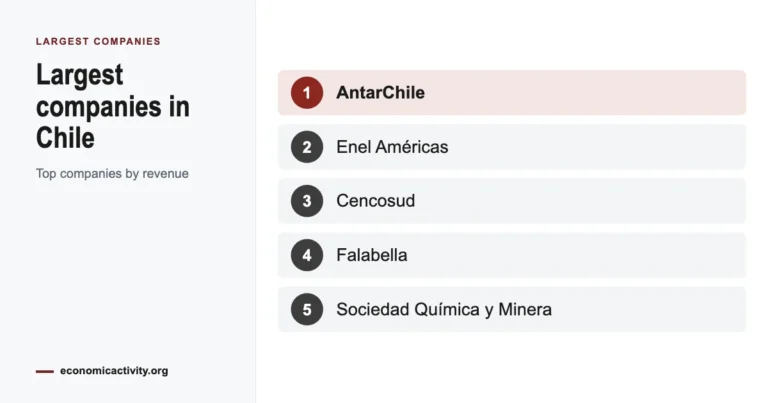
Which is the biggest company in Chile? The largest by market capitalization is SQM (Sociedad Quimica y Minera de Chile), Chile’s leading lithium and specialty chemicals producer, with a market capitalization of approximately $22.8 billion USD as of 2026 (companiesmarketcap.com). Founded in 1968, SQM operates in the materials industry, focusing on mining and chemical production. By revenue, Empresas Copec — a Chilean energy and natural resources conglomerate — reported revenues of approximately $28.3 billion USD in 2024.International Trade of Chile
Import Activities of Chile
 Chile’s import activities are of high importance, with total imports in 2023 amounting to approximately $85.5 billion USD, equivalent to about 25.5% of its GDP (World Bank WITS, 2023).Chile’s key import partners are China (26%), US (22%), Brazil (10%), Argentina (5%), and Germany (3%). The country mainly imports refined petroleum, cars, crude petroleum, garments, and trucks.
Exports Activities of Chile
 Chile’s total exports in 2023 amounted to approximately $94.9 billion USD, accounting for about 28.3% of its GDP (World Bank WITS, 2023). This high percentage shows that exports are a major driver of the country’s economy.Chile’s export activities are primarily focused on copper-related products, with China being its largest export partner at 39%. Other key partners include the US, Japan, South Korea, and Brazil. The country exports commodities such as copper ore, refined copper, carbonates, fish, and raw copper.
Chile economy challenges in 2024
Chile’s export-driven economy faces challenges in 2024. Despite being a leading copper producer, the country grapples with lingering inequality and rising public debt. Political violence has hurt the economy, overshadowing progress in poverty reduction. The COVID-19 rebound was swift, but sustaining growth remains uncertain.Sources
- World Bank: Chile Country Data
- IMF: Chile Country Profile
- World Bank WITS: Chile Trade Summary 2023
- UN Comtrade Plus: Trade Flow
Last updated: October 2026



Leave a Reply