
Supply and demand is the basic force that sets prices in a market. Demand falls as prices rise; supply rises as prices rise. The price settles where the two meet (the equilibrium price), leaving no shortage or surplus. It is the foundation of how markets work.
What are supply and demand?
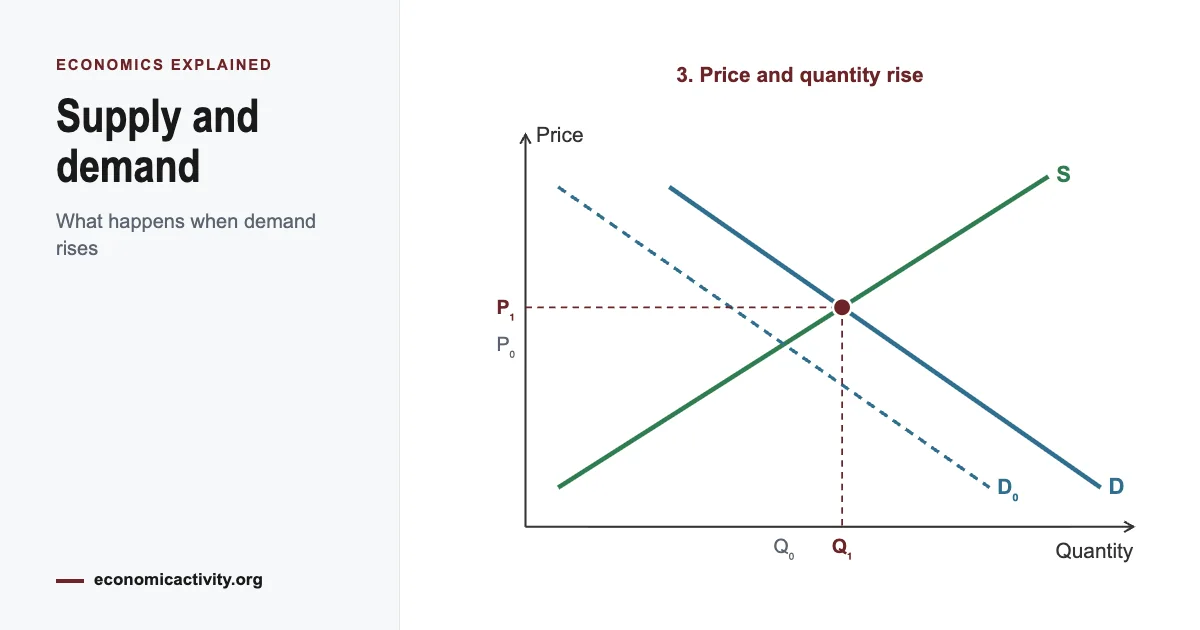
Every price in a market comes from two opposing forces. The law of demand says that as the price of something rises, buyers want less of it. The law of supply says the opposite for sellers: as the price rises, producers want to sell more. Put a downward-sloping demand and an upward-sloping supply on the same chart, and they cross at one point.
How prices are set
That crossing point is the equilibrium price: the price at which the quantity buyers want exactly matches the quantity sellers offer (IMF). If the price is set too high, sellers produce more than buyers will take, creating a surplus that pushes the price down. If it is too low, buyers want more than is available, creating a shortage that pushes the price up. The market naturally moves toward the balance point.

A simple example
Imagine the market for coffee. A bumper harvest floods the market with beans, so supply jumps while demand stays the same. The extra supply creates a surplus, and the price falls until buyers absorb the extra coffee at a new, lower equilibrium. Now imagine a frost destroys part of the crop: supply shrinks, a shortage appears, and the price rises. Nobody sets these prices by decree. They emerge from millions of buyers and sellers responding to each other.

Key takeaways
- Demand falls as prices rise; supply rises as prices rise.
- The equilibrium price is where supply meets demand.
- A price above equilibrium creates a surplus; below it, a shortage.
- Supply and demand is the foundation of how markets set prices.
Why it matters
Supply and demand is the single most important idea in economics. It explains why prices rise and fall, how markets clear shortages and surpluses, and how resources get allocated in a market economy. Almost every economic question, from wages to interest rates to the price of oil, comes back to the interaction of these two forces.
Price elasticity: how strongly buyers react to a price change
The law of demand says buyers want less when the price rises. It does not say how much less. That is measured by the price elasticity of demand: the percentage change in the quantity bought divided by the percentage change in the price. If a 10% price rise cuts purchases by 20%, the elasticity is −2.
Demand is inelastic when buyers barely react, usually because the good is a necessity with no close substitute: petrol for the commute, insulin, electricity. Demand is elastic when buyers react strongly because they can easily switch to something else: one brand of cola, one particular restaurant.
Elasticity decides what a price rise does to total spending, which is also the sellers’ revenue. With inelastic demand the higher price outweighs the small drop in sales, so revenue rises; that is why taxes on fuel and tobacco raise so much money. With elastic demand sales fall so much that revenue drops; that is why a single shop rarely gains by pricing above its rivals. Demand also becomes more elastic over time as people find substitutes: a jump in petrol prices barely changes how much people drive in the first month, but over several years it changes the cars they buy.
Concept check
Does higher demand always raise the price?
What is the equilibrium price?
Can a market have two prices for the same good?
Sources
- IMF, Back to Basics: Supply and Demand — retrieved 2026-07-05 — imf.org
- Encyclopaedia Britannica, Supply and demand — retrieved 2026-07-05 — britannica.com
Last updated: July 4, 2026



Leave a Reply