
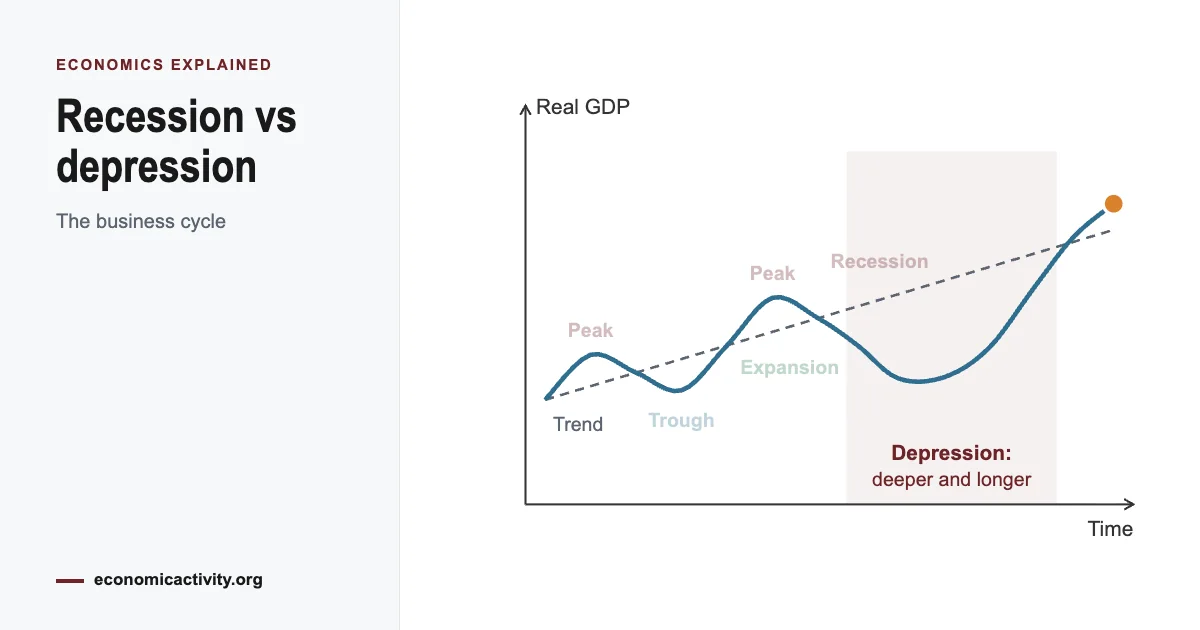
A recession is a significant, economy-wide decline in activity that lasts more than a few months. A depression is a far deeper and longer version of the same thing. It is rarer, more severe, and lasts years. The Great Depression of the 1930s is the defining example.
Recession vs depression: what is the difference?
Both describe an economy in decline, but they differ in scale. The US National Bureau of Economic Research, the official arbiter of recessions, defines a recession as “a significant decline in economic activity that is spread across the economy and that lasts more than a few months” (NBER). A depression has no official definition, but it is understood as a downturn that is much deeper and far more prolonged.
| Dimension | Recession | Depression |
|---|---|---|
| Severity | Moderate decline in output | Severe (Great Depression: ~30% fall in GDP) |
| Duration | Months, usually under two years | Years (1929 to about 1939) |
| Unemployment | Rises moderately | Extreme (around 25% at its worst) |
| Frequency | Common, part of the business cycle | Very rare |
Economists picture recessions on the business cycle: the up-and-down path of real GDP around its long-run trend.
The Great Depression: the benchmark
The Great Depression shows just how much worse a depression is than a recession. In the United States between 1929 and its low point, industrial production fell by nearly half and real GDP dropped by roughly 30%, while unemployment climbed to around 25% (Encyclopaedia Britannica). The slump lasted most of a decade and spread worldwide. By contrast, a typical recession trims a few percent from output and fades within a year or two.
Who decides when a recession starts?
In the United States, the NBER makes the official call, weighing the depth, breadth and duration of a downturn using monthly data on jobs, income, spending and production. A popular rule of thumb (two consecutive quarters of falling GDP) is a rough guide, but the NBER notes that output can fall for two quarters without a true recession, because how deep and how widespread the decline is matters just as much (NBER). A recession that keeps deepening for years can tip into a depression.

Key takeaways
- A recession is a significant, economy-wide decline lasting more than a few months.
- A depression is far deeper, longer and rarer, and is measured in years.
- In the Great Depression, US GDP fell about 30% and unemployment hit ~25%.
- The NBER officially dates US recessions; a depression has no official arbiter.
Okun’s law: why recessions cost jobs
A recession is not only a fall in output; it is a fall in jobs. The link between the two is so regular that economists call it Okun’s law, after the American economist Arthur Okun, who measured it in the early 1960s. When an economy grows at its normal pace, firms hire about enough people to keep unemployment steady. When growth falls below that pace, firms need fewer workers and unemployment rises.
For the United States, a common rule of thumb is that each percentage point of growth below normal adds about half a point to the unemployment rate. If normal growth is about 2% and the economy shrinks by 2%, growth falls 4 points short, and unemployment climbs by around 2 points.
This is why recessions feed on themselves. People who lose their jobs spend less, which cuts sales at other firms, which leads to more layoffs. It also explains why unemployment keeps rising after output has stopped falling: firms wait until a recovery looks real before they hire again. The 2008–09 recession officially ended in June 2009, yet US unemployment kept climbing until it peaked at 10% in October 2009. In a depression the same mechanism runs much further, which is how US unemployment reached around 25% in the 1930s.
Concept check
Is two quarters of negative GDP a recession?
What is the difference between a recession and a depression?
Who declares a recession?
Sources
- NBER, Business Cycle Dating Procedure FAQ — retrieved 2026-07-05 — nber.org
- Encyclopaedia Britannica, Great Depression — retrieved 2026-07-05 — britannica.com
- IMF, Recession: When Bad Times Prevail — retrieved 2026-07-05 — imf.org
Last updated: July 4, 2026

Leave a Reply