
The secondary sector is what most people call industry, taking the output of primary activities and manufacturing new finished goods for consumption. What is the secondary sector of the economy? It is usually divided into light industry, which is labor intensive, and heavy industry. Examples include food, beverage, textile, and apparel manufacturing. It drove the industrial revolution.
The secondary sector of the economy is what most people call the industry. It is a key sector in most of the world economies and it led to important changes in society during the industrial revolution.
The secondary sector in brief
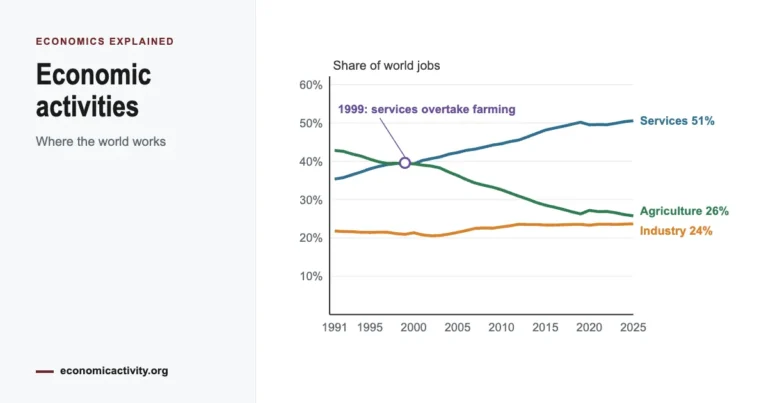
The secondary sector is the part of the economy that transforms raw materials into finished goods. It includes manufacturing, construction, and the processing of food, metals, chemicals and energy. A cotton farmer works in the primary sector; the mill that spins cotton into thread and the factory that sews it into shirts belong to the secondary sector. Its central job is to add value: the shirt is worth far more than the cotton inside it. Economists see manufacturing as a strong engine of growth because factories gain from economies of scale, the division of labor and new machinery, so output per worker can rise quickly. That is how Britain, then the United States, Japan, South Korea and China became industrial powers. Today industry employs about 24% of the world’s workers and produces about 25% of world output. In rich countries its share of jobs is shrinking, a process known as deindustrialization, and the models below explain why.
How the four sectors compare
The secondary sector sits in the middle of the production chain: it buys from the primary sector, sells through the tertiary sector, and increasingly depends on the design and research work of the quaternary sector. The table compares all four.
| Sector | What it does | Typical outputs | Example jobs | Share of world jobs | Share of world output |
|---|---|---|---|---|---|
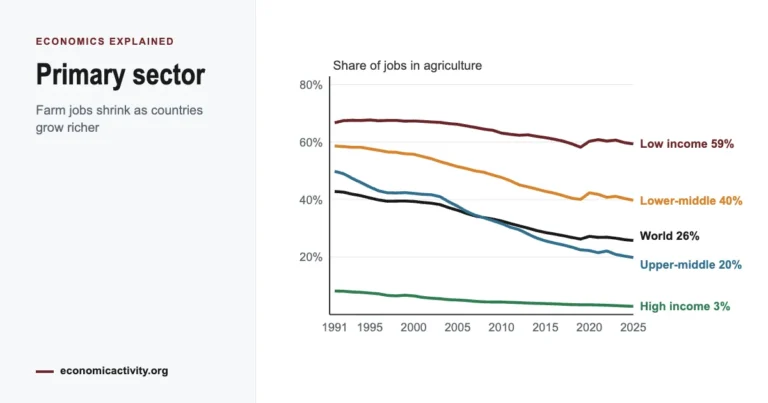
| Primary | Takes resources directly from nature | Crops, livestock, timber, fish, ores, crude oil | Farmer, fisher, forester, miner | About 26% (2025) | About 4% (2025) |
| Secondary | Turns raw materials into finished goods and buildings | Food products, clothing, steel, cars, chemicals, houses | Factory worker, welder, builder, machine operator | About 24% (2025) | About 25% (2025) |
| Tertiary | Provides services to people and businesses | Retail, transport, health care, banking, tourism | Shop assistant, nurse, driver, bank clerk | About 51% (2025) | About 63% (2024) |
| Quaternary | Creates, processes and shares knowledge | Research results, software, data, patents, expert advice | Scientist, software engineer, analyst, consultant | Counted inside services | Counted inside services; R&D spending is about 2.6% of world GDP (2023) |
What is the secondary sector?
The secondary sector or secondary economic activity definition: includes economic activities that create finished products for consumption (consumer goods). It takes the production of the primary activities and manufactures new end goods.
Usually, secondary activities are divided into two sectors: light industry and heavy industry.

Light industries of the secondary sector
Light industry is mostly labor intensive and does not require large quantities of raw materials or large areas for production. It is also more geared towards producing for the end consumer than for other companies.
Examples of light industries of the secondary sector
- Food manufacturing such as dog and cat food manufacturing, flour and rice milling, and malt, breakfast cereal, chocolate and confectionery, frozen food, dried and dehydrated food, ice cream and frozen dessert manufacturing, etc.
- Beverage and tobacco product manufacturing such as soft drink and ice, bottled water manufacturing, wineries, breweries, and distilleries.
- Textiles mils, textile product mills, apparel manufacturing, leather, and allied product manufacturing.
Heavy industries of the secondary sector

Heavy Industry refers to the production of large-scale goods with a large-scale manufacturing process. In this type of industry, the use of capital is intensive. It employs a lot of raw materials, facilities, and areas for production.
Examples of heavy industries of the secondary sector
- Petroleum and Coal Products Manufacturing such as petroleum refineries, asphalt paving mixture, asphalt shingle, and coating materials manufacturing.
- Chemical manufacturing such as petrochemical, industrial gas, synthetic dye and pigment, and ethyl alcohol manufacturing. Also pesticide, fertilizer, and other agricultural chemical manufacturing.
- Glass and glass products.
- Cement and concrete production.
- Iron and steel mills and ferroalloy manufacturing, steel product manufacturing, alumina, and aluminum production and processing.
- Agriculture, construction, mining, and industrial machinery manufacturing.
- Transportation Equipment Manufacturing such as motor vehicle body and trailer manufacturing, aerospace product and parts manufacturing, and ship and boat Building.
Characteristics of the secondary sector of the economy
- World industry is concentrated in the United States, China, Europe, Japan, India, and South Korea.
- Light industries are located in urban areas, while heavy industries located mostly outside urban areas.
- Capital and labor intensive
- Depends on raw materials from the primary sector of the economy.
The economic logic of the secondary sector
Manufacturing has a special place in economics because it was the sector that first lifted whole countries out of poverty. Several simple ideas explain why.
Value added: measuring what a factory contributes
Economists measure each producer by the value it adds: the price of what it sells minus the cost of the materials it buys. Adding up value added, instead of total sales, stops the same cotton from being counted three times in a country’s GDP.
Example: A farmer sells cotton to a mill for $2. The mill turns it into cloth and sells it for $5, adding $3 of value. A garment factory sews the cloth into a shirt sold for $15, adding $10. The shirt’s $15 price equals the sum of the value added at each stage: $2 + $3 + $10.
Division of labor and economies of scale
In 1776 Adam Smith described a pin factory where ten workers, each doing one small step, made about 48,000 pins a day. Working alone, Smith thought, each might not have made even twenty. Splitting work into specialized tasks is the division of labor. Large factories also enjoy economies of scale: the bigger the output, the lower the cost of each unit, because expensive machines and buildings are shared across more products.
Example: A factory pays $1 million a year for its building and machines, and $5 in materials and labor for each bicycle. If it makes 10,000 bicycles, each costs $105 ($100 of fixed cost plus $5). If it makes 1 million, each costs just $6. This is why manufacturers chase large markets and why export-oriented factories can undercut small local workshops.
Light industry, heavy industry and comparative advantage
Light industries such as clothing, shoes and food processing need many workers but relatively little machinery. Heavy industries such as steel, chemicals and shipbuilding need enormous amounts of capital. The theory of comparative advantage predicts that a country with many workers and little capital will start with light industry, because that is what it can produce relatively cheaply, and move toward heavier, more capital-intensive industry as it saves and invests.
Manufacturing as an engine of growth
The economist Nicholas Kaldor argued that manufacturing drives the rest of the economy. Factory productivity can rise much faster than productivity in farming or personal services, factory goods can be sold worldwide, and each factory creates demand for suppliers, transport and repairs. In the three-sector model of Allan Fisher and Colin Clark, industry is the stage that carries a country from a farm economy to a service economy.
Deindustrialization and the smile curve
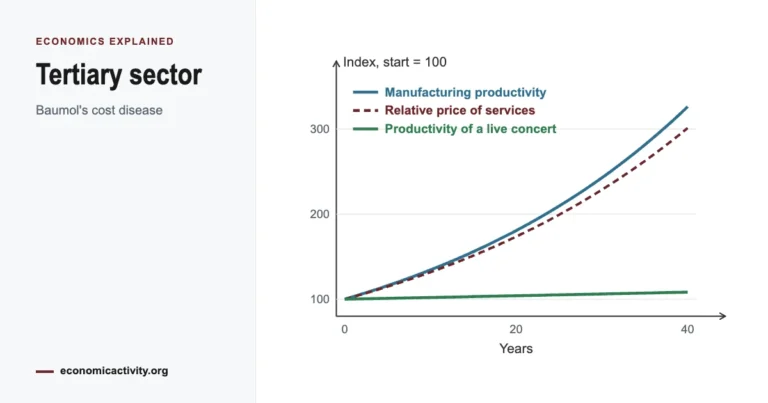
As productivity in factories keeps rising, fewer workers are needed to make the same goods, while rising incomes shift spending toward services. The result is deindustrialization: manufacturing’s share of jobs falls even when factory output keeps growing. The economist Dani Rodrik has shown that many developing countries now reach their manufacturing peak earlier, at lower incomes, than Europe did, partly because of automation and competition from Asian factories. He calls this premature deindustrialization.
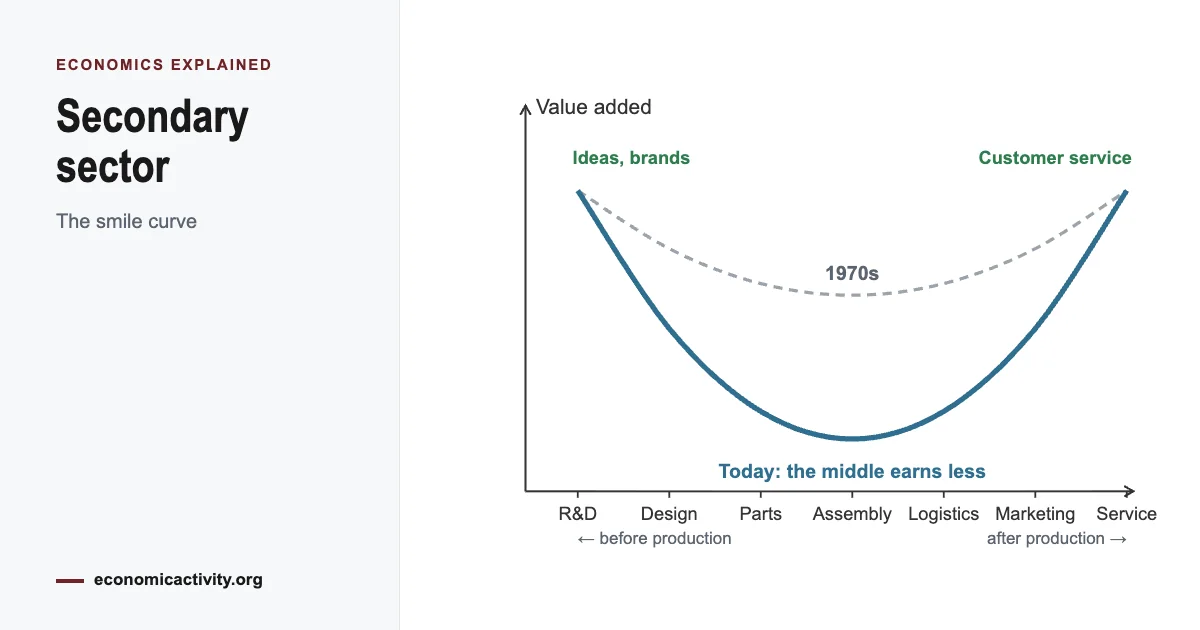
Inside a global supply chain, the most valuable steps are often not the factory work itself. The smile curve, first drawn by Acer’s founder Stan Shih, shows high value at the start (research and design) and at the end (branding, marketing and after-sales service), with assembly in the low middle. That is why rich countries try to keep design and brands at home even when assembly moves abroad.
Secondary sector examples by country
Countries reach the secondary sector by very different routes. These pages show how manufacturing fits into each economy.
Ireland: manufacturing produces about 34% of GDP (2025), and high-technology products make up about 54% of manufactured exports (2024). Foreign pharmaceutical, medical-device and electronics companies drive these figures, and part of the value they record in Ireland reflects profits booked there for tax reasons.
Lesotho: industry employs about 33% of workers (2025), and manufactured goods make up about 70% of merchandise exports (2024), much of it clothing sewn for export. It is a clear case of starting with labor-intensive light industry.
Seychelles: food makes up about 86% of merchandise exports (2024), largely canned tuna. One processing industry connects the islands’ fishing fleets to world markets, adding value before the fish leaves the country.
Namibia: industry, including mining, produces about 29% of GDP (2025), and ores and metals make up about 32% of merchandise exports (2024). Policy has long aimed to process more diamonds and minerals at home instead of exporting them raw, so that more of the value is added inside the country.
India: industry employs about 26% of workers, while manufacturing produces about 13% of GDP (2025). Government programs such as Make in India aim to raise that share and absorb workers leaving agriculture.
United Kingdom: manufacturing produces about 8% of GDP (2025). The birthplace of the Industrial Revolution is now one of the clearest examples of deindustrialization.
Canada: manufacturing produces about 9% of GDP (2022), and manufactured goods make up about 40% of merchandise exports (2025), with cars and car parts among the largest.
Last updated: October 2026

Leave a Reply