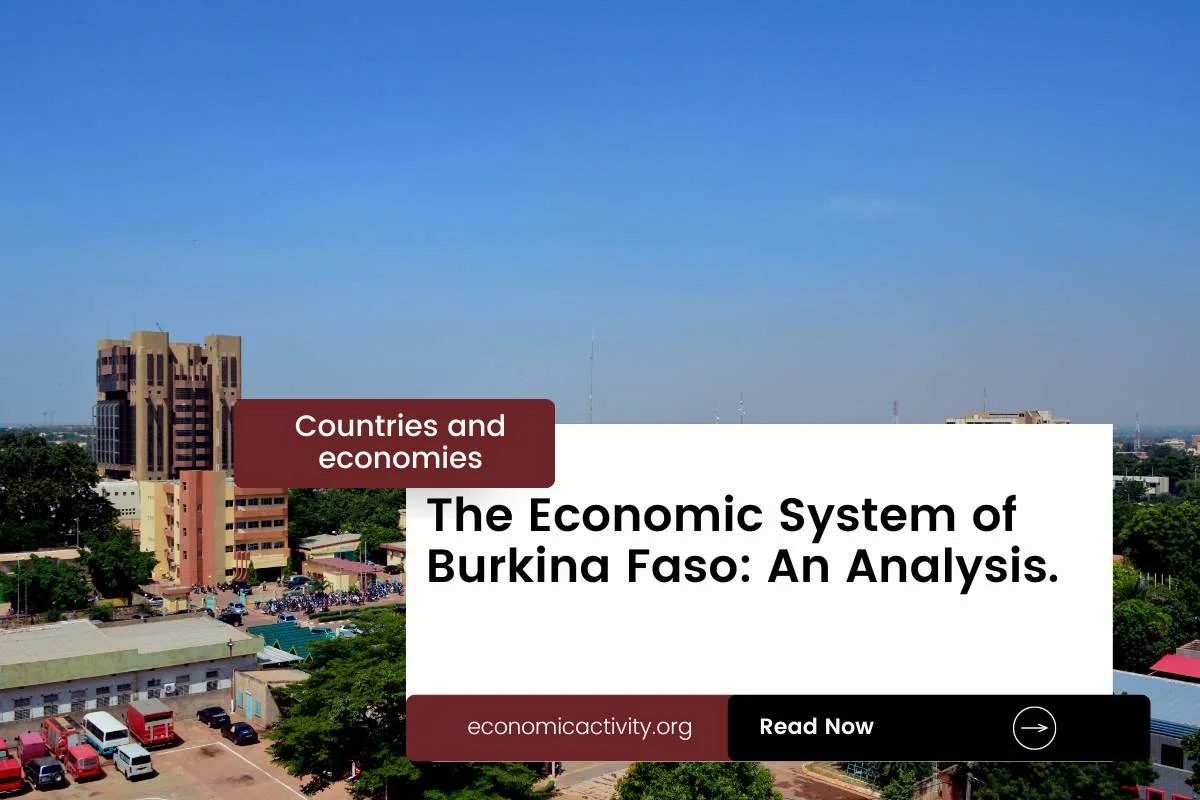
Burkina Faso's economic system is a mixed economy that blends private enterprise with state direction over certain goods and services. What type of economic system does Burkina Faso have? The 2026 Index of Economic Freedom scores it 49.1 out of 100, ranking 122nd globally as Mostly Unfree, while Freedom House rates it 20/100 Not Free after the 2022 coups.
What is the economic system of Burkina Faso? The economy of Burkina Faso is based on a mixed economy. The country’s economic system combines elements of a market economy and a planned economy.
No country is purely capitalist or purely communist.
What do the freedom indexes tell about the economic system of Burkina Faso?
For instance, according to the 2026 Index of Economic Freedom, which measures the ability of every human to control his own labor and property, Burkina Faso scores 49.1 out of 100, ranking 122nd globally and placing it in the Mostly Unfree category. This indicates that the country has a mostly unfree economy, reflecting significant state intervention and institutional constraints.
In a similar way, the Freedom House Freedom in the World 2026 report evaluates the state of political rights and civil liberties globally. Burkina Faso gets a score of 20/100, which qualifies it as Not Free. Following the military coups of 2022 and the junta’s consolidation of power, political rights and civil liberties have been severely curtailed, with the government exerting broad control over economic and public life.
What does the biggest company in Burkina Faso say about the country’s economic system?
The biggest company in Burkina Faso should also be looked at, as well as whether it is a state-owned or private company. In this case, SONABHY (Société Nationale Burkinabè des Hydrocarbures) is the largest company in Burkina Faso by revenue. SONABHY is a fully state-owned enterprise responsible for importing, storing, and distributing petroleum products. In 2024, it generated approximately 1,443 billion CFA francs in revenue, representing nearly 47% of all revenue from Burkina Faso’s state-owned enterprises. Its dominant role reflects the significant weight of the public sector in Burkina Faso’s economy.
The historical factors that have influenced the economic system of Burkina Faso
The mixed economy system of Burkina Faso in the last century has been shaped by the combination of colonial rule, post-independence economic policies, and global economic forces. A colonial rule introduced a market-based economy, while post-independence policies focused on state control of the economy and increased investment in infrastructure and education. Global economic forces have also had an impact, with globalization increasing trade and foreign investment, as well as access to capital. The result is a mixed economy in which the state plays an important role, but private enterprise also has a significant presence.
Sources
- List of countries by the public sector size
- ILOSTAT – Burkina Faso country profile
- 2026 Index of Economic Freedom – Burkina Faso
- Freedom in the World 2026 – Burkina Faso
- SONABHY – Burkina Faso state enterprise performance 2024 (Horonya Finance)
Last updated: August 2026


Leave a Reply