
Key Economic Insights: The economy of Luxembourg generates an estimated GDP of $101.16 billion ($147,252 per capita) supporting a population of 686,970. Productive output is anchored by 81.4% services, 8.9% industry and manufacturing, and 0.2% agriculture and natural resource extraction. Key merchandise exports include iron blocks, plastic products, rubber tires, plastics, and gas turbines.
Luxembourg, a small but prosperous country in Europe, boasts a strong economic position. As of 2025, its GDP stands at approximately $101.16 billion, ranking among the smaller economies of the EU. Additionally, Luxembourg’s GDP per capita is impressive at about $147,252 (as of 2025), one of the highest in the world.
It falls behind Liechtenstein, with a GDP per capita of $180,227. Luxembourg’s economy is characterized by a high standard of living and a strong financial services sector.
Luxembourg Economic Structure & Sector Analysis
| Economic Dimension | Figure | Authoritative Source |
|---|---|---|
| GDP & Macro Output | Nominal GDP: $101.16 billion | Per Capita: $147,252 | World Bank WDI / IMF |
| Sector Breakdown | Services: 81.4% | Industry: 8.9% | Agriculture: 0.2% | World Bank National Accounts |
| Trade & Commodities | Top Exports: iron blocks, plastic products, rubber tires, plastics, and gas turbines | UN Comtrade / OEC |
| Demographics & Labor | Population: 686,970 | ILO / UN Population Division |
- Primary activities: 0.2% of GDP.
- Secondary activities: 8.9% of GDP.
- Tertiary activities: 81.4% of GDP.

Primary Sector of Luxembourg
Luxembourg’s primary sector, particularly agriculture, thrives due to its temperate climate and fertile soil. With 51.59% of the land dedicated to agriculture, the country produces a variety of crops and animal products. The main agricultural products include milk, wheat, barley, triticale, potatoes, pork, grapes, beef, oats, and rapeseed.
Agriculture contributes only 0.3% to the GDP but provides employment and helps ensure food security. The diverse range of agricultural products highlights the sector’s importance in sustaining Luxembourg’s agricultural industry.
Luxembourg’s geological diversity has shaped its resource availability. The primary sector relies on arable land for agriculture, contributing significantly to the economy. Although iron ore is no longer exploited, the country’s primary sector still depends on its natural resources, mainly arable land.Luxembourg’s natural gas production in 2020 reached 6 million m³, ranking the country 97th in the world.Secondary Sector of Luxembourg
In Luxembourg, main industrial products include construction, real estate services, iron, metals, steel, information technology, cargo transportation, logistics, chemicals, engineering, tires, glass, aluminum, and biotechnology.Manufactures accounted for 81.39% of Luxembourg’s total exports in 2023. They drive economic growth, create jobs and contribute significantly to the country’s trade balance.Tertiary sector of Luxembourg

Military Activities and Economic Sectors of Luxembourg
In the primary sector, resources are extracted for military use. The secondary sector focuses on manufacturing military equipment. The tertiary sector includes services provided by the military, like training and logistics. The quaternary sector deals with military research and development, while the quinary sector involves high-level decision-making and strategy.
In Luxembourg, the military expenditure for 2023 is 662.5 million US dollars, which is 0.7% of the country’s GDP. The active military force has 900 personnel, resulting in 2.5 active military members per 1,000 people.
Biggest company in Luxembourg
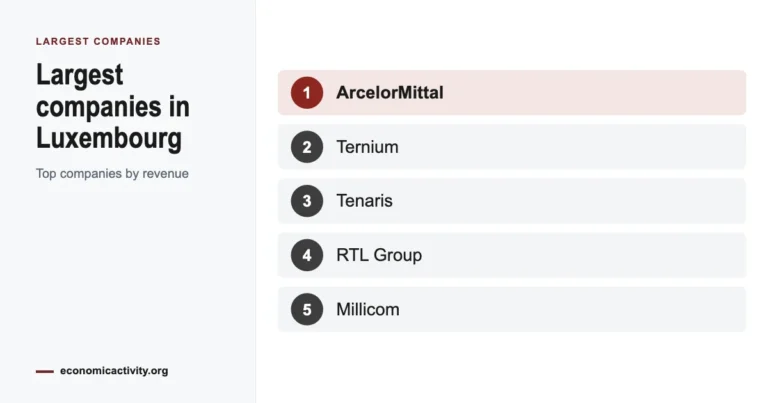
Which is the biggest company in Luxembourg? It’s ArcelorMittal, a leading steel manufacturing company. As of 2025, it has a market value of approximately $29 billion, and it operates in the materials industry, specifically in the primary sector. ArcelorMittal was founded in 2006.International Trade of Luxembourg
Import Activities of Luxembourg
 Luxembourg’s import activities are of high importance, with total imports of goods reaching about $25.2 billion (2023), equivalent to roughly 27% of the country’s GDP.Luxembourg’s key imports include refined petroleum, cars, electricity, natural gas, and scrap iron. Its main import partners are Belgium (26%), Germany (26%), France (11%), the Netherlands (6%), and the US (3%). These imports support the country’s economy and meet its domestic needs.
Exports Activities of Luxembourg
 Luxembourg’s total exports of goods in 2023 amounted to about $20.5 billion, making up roughly 22% of its GDP. Export activities hold high importance, driving economic growth and global connections in the country.Luxembourg’s export activities are diversified, with key partners including Germany, France, Belgium, Netherlands, and Italy. The country mainly exports iron blocks, plastic products, rubber tires, plastics, and gas turbines.
Luxembourg economy challenges in 2024
Luxembourg, a high-income EU country, faces challenges in 2024. Despite a highly capitalized banking sector and high GDP per capita, it is recovering from economic contraction due to energy-driven inflation, reduced exports, and financial sector weakness.Sources
- World Bank: Luxembourg
- IMF: Luxembourg
- STATEC (Luxembourg National Statistics)
- UN Comtrade Plus: Trade Flow
Last updated: October 2026

Leave a Reply