
Key Economic Insights: The economy of Hong Kong generates an estimated GDP of $427.31 billion ($56,983 per capita) supporting a population of 7,498,900. Productive output is anchored by 91.5% services, 6.2% industry and manufacturing, and 0.04% agriculture and natural resource extraction. Key merchandise exports include gold, integrated circuits, and broadcasting equipment, driving economic growth and trade relationships worldwide, directed primarily toward China and India.
Hong Kong SAR, China holds a strong economic position with a GDP of approximately $427.31 billion (As of 2025), ranking among the larger economies globally. The economy grew by 2.5% in real terms in 2024. Its GDP per capita stands at approximately $56,983 (As of 2025), among the highest in the world.
Hong Kong SAR, China is a key player in the global market, with steady growth and a focus on innovation and technology.
Hong Kong Economic Structure & Sector Analysis
| Economic Dimension | Figure | Authoritative Source |
|---|---|---|
| GDP & Macro Output | Nominal GDP: $427.31 billion | Per Capita: $56,983 | World Bank WDI / IMF |
| Sector Breakdown | Services: 91.5% | Industry: 6.2% | Agriculture: 0.04% | World Bank National Accounts |
| Trade & Commodities | Top Exports: gold, integrated circuits, and broadcasting equipment, driving economic growth and trade relationships worldwide | UN Comtrade / OEC |
| Demographics & Labor | Population: 7,498,900 | ILO / UN Population Division |
| Strategic Trade Corridors | Leading Trade Partners: China and India | World Bank WITS / IMF DOTS |
- Primary activities: 0.04% of GDP.
- Secondary activities: 6.2% of GDP.
- Tertiary activities: 91.5% of GDP.

Primary Sector of Hong Kong
The primary sector in Hong Kong, with 3.81% agricultural land, is mainly focused on high-value crops due to limited space and urbanization. Key products include pork, chicken, spinach, vegetables, game meat, pork offal, fruits, onions, lettuce, and pork fat.
Agriculture contributes only 0.04% to the GDP, but it preserves traditional practices and supports food security. The variety of crops and animal products highlights the sector’s importance in providing fresh, locally sourced produce for the population.
Hong Kong’s geological diversity, with its outstanding deepwater harbor and feldspar deposits, has shaped its primary sector. The harbor supports trade, while feldspar mining contributes to the economy through ceramics and glass manufacturing.Secondary Sector of Hong Kong
In Hong Kong, the main industrial products include trading and logistics, professional services, cultural and creative goods, clothing and textiles, shipping services, electronics, toys, clocks, and watches.Manufactures play a critical role in Hong Kong’s total exports, accounting for 88.77% in 2023.Tertiary sector of Hong Kong

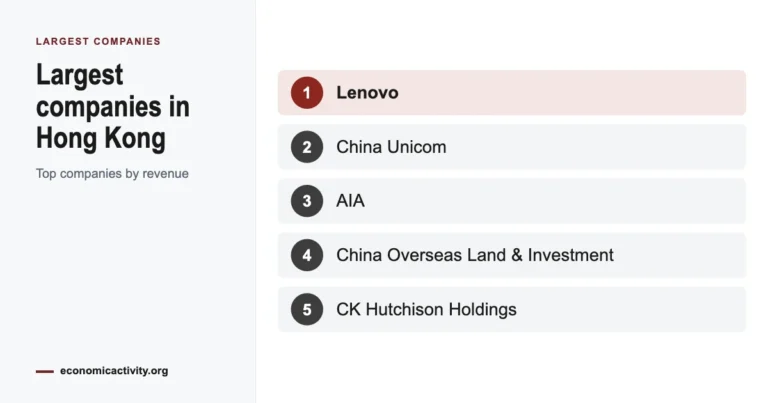
Biggest company in Hong Kong
Which is the biggest company in Hong Kong? It’s AIA Group, a pan-Asian life insurance and financial services group headquartered in Hong Kong. With a market value of approximately $97 billion (As of 2025), it is the largest Hong Kong-domiciled listed company and a key player in the tertiary (financial services) sector. AIA was established in Asia in 1919 and listed on the Hong Kong Stock Exchange in 2010.International Trade of Hong Kong
Import Activities of Hong Kong
 Hong Kong’s import activities are of high importance, with total imports in 2023 reaching $654.82 billion (As of 2023), equivalent to about 161% of its 2024 GDP — a level that reflects Hong Kong’s role as a major trade and re-export entrepot.Hong Kong’s major import partners include China, Taiwan, Singapore, South Korea, and Japan. Key imports include integrated circuits, broadcasting equipment, machine parts, gold, and jewelry.
Exports Activities of Hong Kong
 Hong Kong’s total exports in 2023 reached $575 billion (As of 2023), equivalent to about 141% of its 2024 GDP. Because Hong Kong is a global entrepot, its trade flows substantially exceed domestic output.Hong Kong’s export activities are diverse, with key partners like China and India. Major exports include gold, integrated circuits, and broadcasting equipment, driving economic growth and trade relationships worldwide.
Hong Kong economy challenges in 2024
Hong Kong, a high-income tourism and services-based economy, faces challenges in 2024. Despite being a global financial hub, the recent recession due to COVID-19 and political protests has led to high unemployment, especially among lower-skilled workers. The country is focusing on recovery and investing in job-reskilling programs to address this issue.Sources
- World Bank: Hong Kong SAR, China
- IMF: Hong Kong SAR
- Census and Statistics Department, Hong Kong
- Trading Economics: Hong Kong GDP
Last updated: October 2026



Leave a Reply