
The tertiary sector is the service sector, producing intangible services instead of end goods, and it is the most important part of modern economies. What is the tertiary sector of the economy? It makes up more than 60% of output in developed countries and employs most of the world's workforce. Examples include wholesale and retail trade, transportation, and warehousing.
The tertiary economic activity or sector is the most important in modern economies. It represents more than 60% of GDP in developed countries and employs most of the workforce of the world.
The tertiary sector in brief
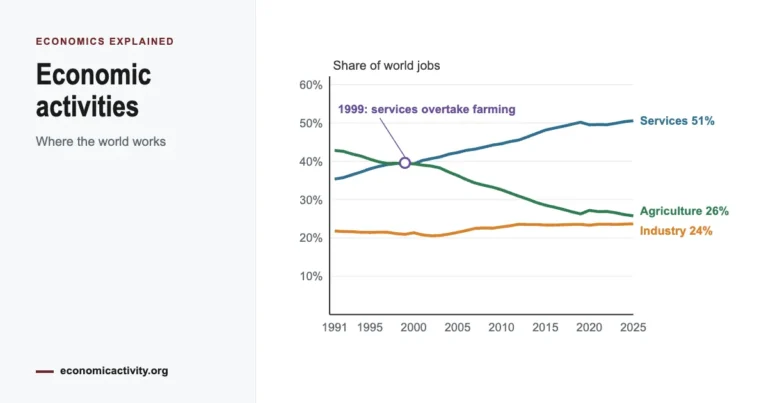
The tertiary sector, or service sector, is made up of activities that provide a service instead of a physical product. Shops, transport, banking, insurance, health care, education, tourism, restaurants and government services all belong here. A service is usually used up the moment it is produced: you cannot store a haircut or a bus ride for later. Services are the largest sector of the modern economy, producing about 63% of world output and employing about 51% of the world’s workers. Their share grows as incomes rise, because once households have enough food and goods, they spend most of each extra dollar on health, education, travel and entertainment. Economists call this shift tertiarization. The sector also raises puzzles that simple economic models help explain, such as why education and health care tend to become more expensive over time while televisions and clothes become cheaper, and why some services can be exported across the world while others must be bought locally.
How the four sectors compare
The tertiary sector connects the others: it moves raw materials and finished goods, sells them, finances them and serves the people who make them. The table compares all four sectors.
| Sector | What it does | Typical outputs | Example jobs | Share of world jobs | Share of world output |
|---|---|---|---|---|---|
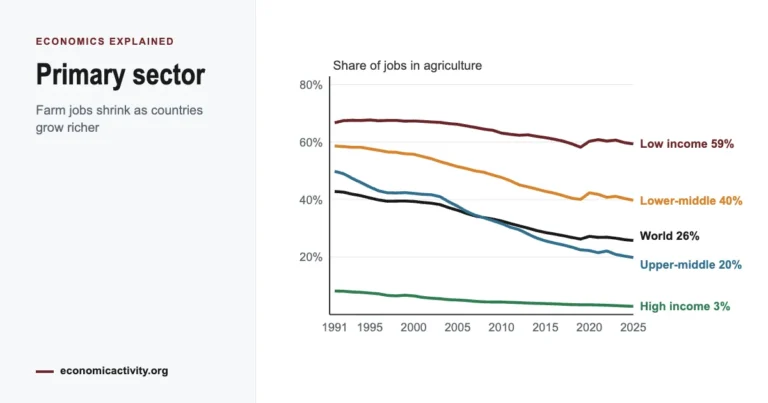
| Primary | Takes resources directly from nature | Crops, livestock, timber, fish, ores, crude oil | Farmer, fisher, forester, miner | About 26% (2025) | About 4% (2025) |
| Secondary | Turns raw materials into finished goods and buildings | Food products, clothing, steel, cars, chemicals, houses | Factory worker, welder, builder, machine operator | About 24% (2025) | About 25% (2025) |
| Tertiary | Provides services to people and businesses | Retail, transport, health care, banking, tourism | Shop assistant, nurse, driver, bank clerk | About 51% (2025) | About 63% (2024) |
| Quaternary | Creates, processes and shares knowledge | Research results, software, data, patents, expert advice | Scientist, software engineer, analyst, consultant | Counted inside services | Counted inside services; R&D spending is about 2.6% of world GDP (2023) |
What is the tertiary economic activity or sector?
- Definition 1: the tertiary economic activity or service sector encompasses the production of services instead of end goods that meet the needs of individuals.
- Definition 2: the tertiary sector is composed of the “soft” parts of the economy, that is, activities where people offer their knowledge and time to improve the productivity, performance, potential, and sustainability of the economy.

Services are also known as intangible goods and include care, advice, experience, and discussion, among others.
The tertiary economic activity involves providing services both to consumers (B2C) and to other companies (B2B). For example, consulting services from a digital agency to an online store.
Examples of tertiary economic activities:
- Wholesale trade such as furniture and home furnishing, lumber and other construction materials, office equipment; medical, dental, and hospital equipment and supplies; household appliances and electrical and electronic goods; farm and garden machinery and sporting and recreational goods.
- Retail trade such as motor vehicle and parts dealers, furniture and home furnishings stores, electronics and appliance stores, grocery and internet retailers.
- Transportation and warehousing such as air, rail, water and truck transportation; transit and ground passenger transportation; pipeline transportation, postal service; couriers and messengers.
- Publishing industries, motion pictures and sound recording, telecommunications, data processing, and hosting.
- Finance and insurance.
- Real estate and rental and leasing.
- Professional, scientific, and technical services such as legal, accounting, architectural, engineering, and marketing consulting services.
- Educational services.
- Health care and social assistance such as offices of physicians, outpatient care centers, and medical and diagnostic laboratories.
- Arts, entertainment, and recreation.
- Accommodation and food services such as hotels, casinos, special food services, drinking places, and restaurants.

Secondary and tertiary economic activities
Quaternary and tertiary economic activities
Importance of the tertiary sector and tertiarization
The economic logic of the tertiary sector
Services follow different economic rules from farms and factories. Four ideas from economics explain most of their behavior.
What makes a service different
A service is intangible (you cannot touch it), usually produced and consumed at the same time, and cannot be stored. An empty hotel room tonight is income lost for good. Many services also need the customer to be present, which for most of history meant they could only be sold locally.
Rising incomes and the demand for services
Economists measure how strongly spending responds to income with income elasticity. Food has a low income elasticity: when people get richer, they buy only a little more of it. Many services have a high one: spending on restaurants, travel, health care and education rises faster than income.
Example: When a family’s income rises by 10%, its spending on groceries might rise by 3%, while its spending on eating out and holidays rises by 15%. Multiplied across millions of households, this is what turns a factory economy into a service economy.
Baumol’s cost disease
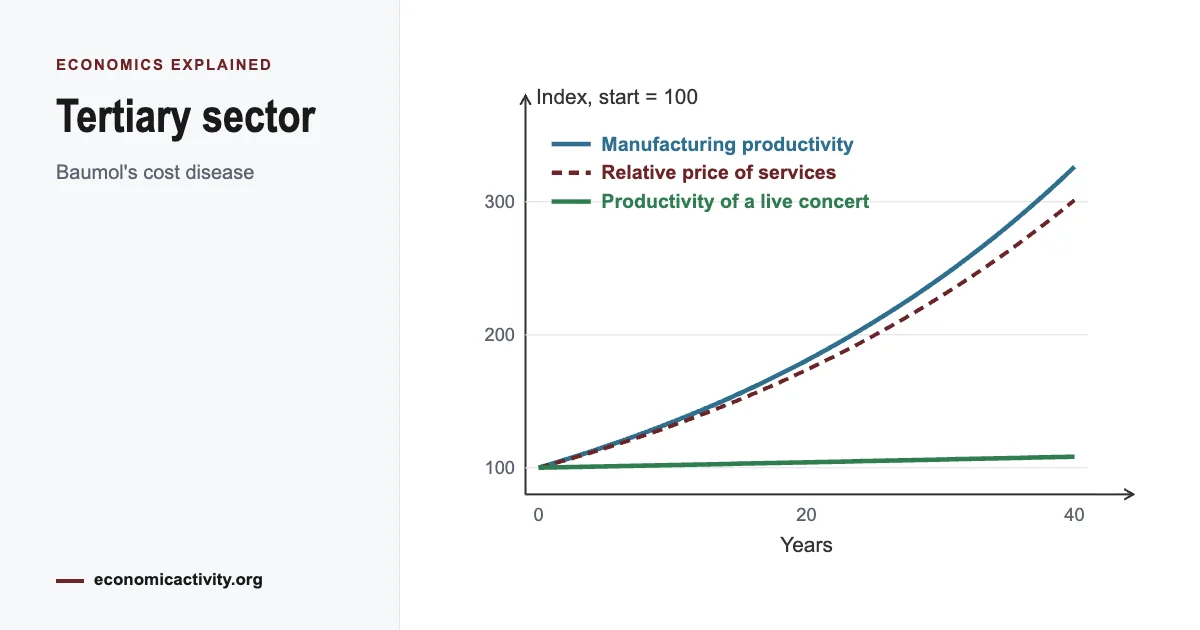
In the 1960s the economist William Baumol noticed that a string quartet needs four musicians and about the same playing time today as it did in Beethoven’s era, while a car factory produces many times more cars per worker than it did a century ago. Yet musicians, teachers and nurses must be paid wages that keep pace with the rest of the economy, or they would switch jobs.
Example: A teacher with 25 pupils teaches about as many students as a teacher did in 1950, but the teacher’s salary has risen along with factory wages. Because productivity in teaching has barely changed, the cost of each year of schooling goes up compared with the price of manufactured goods. This cost disease helps explain why education and health care keep getting more expensive.
Tradable and non-tradable services
A haircut must be delivered in person, so its price depends on local wages: it is cheap in Manila and expensive in London. Economists call such services non-tradable. Software, call-center support, accounting and design can now be delivered over the internet, so they are tradable and follow the same logic of comparative advantage as manufactured goods. This is why some developing countries have become large service exporters.
Hubs and network economies
Some cities and countries specialize in services that depend on location and connections: ports, airports, banking centers and trading hubs. Each new airline route or bank makes the hub more useful to everyone else, a self-reinforcing effect economists call network economies.
Tertiary sector examples by country
These country pages show how the service sector shapes very different economies.
United Kingdom: services employ about 83% of workers and produce about 73% of GDP (2025). Exports of services reached about $719 billion in 2025, led by finance, consulting, law and education sold abroad.
Singapore: about 86% of workers are in services (2025). The city-state built its economy as a hub for shipping, finance and regional headquarters, a clear case of network economies.
Philippines: services employ about 60% of workers (2025), and computer and information services make up about 17% of service exports (2025). English-speaking call centers and business-process outsourcing show how a lower-wage country can export tradable services.
Ireland: computer and information services make up about 65% of service exports (2025), because many large software and internet companies run their European operations from Dublin.
Australia: services employ about 79% of workers (2025). Teaching international students and hosting tourists are among the country’s largest service exports.
New Zealand: before the pandemic, spending by international tourists equaled about 19% of total exports (2018), showing how a non-tradable service becomes an export when the customer travels to the producer.
United Arab Emirates: services produce about 55% of GDP (2024). Dubai’s airports, ports and trading companies are an example of an economy diversifying away from oil through hub services.
Canada: about 80% of workers are in services (2025), even though natural resources dominate its merchandise exports.
The Impact of AI on Tertiary Jobs
The integration of Artificial Intelligence (AI) into the workforce is not merely a futuristic speculation but an imminent reality, with massive investments paving the way for its widespread adoption. Goldman Sachs estimates that by 2025, nearly $200 billion will be invested in AI-related technology globally. This brings significant concerns regarding the displacement of workers, particularly in the tertiary sector.
AI: Just Good Enough
One of the critical issues with AI deployment in the tertiary sector is the notion of it being “just good enough” to replace human workers without delivering substantial productivity gains. This scenario implies that while AI can perform tasks sufficiently well to substitute human labor, it does not enhance efficiency to a degree that benefits businesses or the economy at large. As a result, both workers and society are at risk of losing out.
Also, generative AI (GenAI) is poised to make its most significant impact on high-skilled, professional work—the roles that have long been considered impervious to automation. More information on this topic is available through ongoing research into AI and employment trends.
While early adopters of GenAI might witness increased productivity as roles are automated, augmented, or transformed, this does not necessarily translate to economic growth. The broader economy may lag, unable to keep pace with the rapid leaps in worker productivity. This disparity can lead to widespread workforce reductions over the coming decade.
Last updated: October 2026


Leave a Reply