
Economic agents are the actors who intervene in the economy under rules set by the economic system and institutions, making decisions to solve a choice problem. What are economic agents? Economists generally count three or four types, including families, who consume, work, and save. The concept was created to simplify and explain how economic processes work.
What are economic agents? economic agents are actors who intervene in the economy under certain rules determined by the economic system and economic institutions. They make decisions trying to resolve an optimization or choice problem. In this process, they mold the economy; for example, they decide the distribution of goods and services, taxes, laws, tariffs, etc.
Another definition of economic agents, also known as economic actors, considers them as decision makers who are able to recognize different economic factors, incentives, and motivations of the different economic groups.
The concept of “economic agents” was created by economists to simplify and explain economic processes. As a concept, it was first used in classical and neoclassical models where economists construct a simplified framework representing the economic process by a set of variables and a set of logical relationships between them.
What are the four economic agents? In general, economists consider three or four types of economic agents:
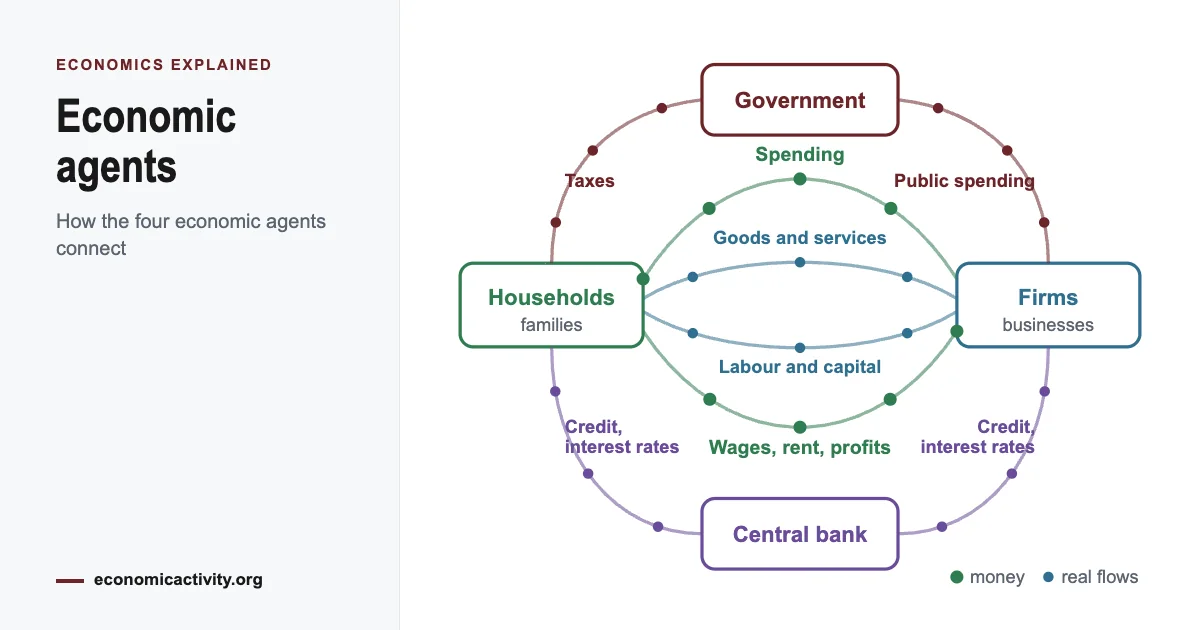
Economists link the four agents in the circular flow of income.
Economic agent: families

Families are a domestic group defined by the U.S. Census as “a group of two people or more (one of whom is the householder) related by birth, marriage, or adoption and residing together; all such people (including related subfamily members) are considered as members of one family”.
Families consume, work and save. They consume to satisfy their necessities, they save for greater future consumption, they borrow to advance consumption, and they work (sacrificing leisure) to be able to consume. Their income is distributed in consumption, savings, and taxes.
They have a dual role in the economy. On one side, they are consumers, they demand goods and services; and on the other, they own the means of production through which the goods and services are produced.
Economic agent: firms

Firms try to maximize their utility (economic benefits) for their shareholders. To achieve this, firms use factors of production (land, labor, and capital) to produce goods and services, creating value and wealth.
They demand labor from families for a salary, and also employ capital (machines, vehicles, computers, etc) in exchange for interest, and land for rent. Finally, They offer goods and services for families, other firms, or the government.
Economic agent: government

Governments provide most of the rules for how the rest of the economic agents should interact. They offer goods and services (mostly public goods and services like roads or national security) through national companies or in association with private firms.
Governments demand goods from firms and labor from families. But also they tax them based on their income, profits, wealth, etc.
They can regulate prices, limit or prohibit the consumption of certain goods, create tariffs, on imports, incentivize production, etc. Finally, they distribute the wealth through social services in education, health, and poverty programs.
Economic agent: Central Banks

Central Banks manage the country’s currency, money supply, and interest rates. Through monetary policies, they can increase the money supply in the economy or modify the interest rates to incentivize or disincentivize consumption, savings, or investments.
The multiplier: how one agent’s spending becomes another’s income
In the circular flow, every payment is also somebody’s income. That simple fact gives rise to the spending multiplier: when one economic agent spends more, total income in the economy rises by more than the original amount.
Suppose the government spends $100 repairing a road. The construction firm and its workers receive $100 of income. If they spend 80% of it and save the rest, $80 flows to shops. The shop owners and their staff spend 80% of that, $64, and so on. Each round is smaller, but they add up: 100 + 80 + 64 + 51 + … comes to about $500. The share of extra income that people spend is the marginal propensity to consume, and the multiplier equals 1 ÷ (1 − that share): here 1 ÷ 0.2 = 5.
In real economies the multiplier is much smaller than 5, because part of every dollar leaks out of the loop at each round: some is saved, some is paid in taxes, and some is spent on imports and becomes income abroad. Its size also depends on the central bank. If spending rises while the economy is weak and interest rates stay low, the multiplier is larger; if the central bank raises rates to cool the economy, much of the effect is cancelled out. The mechanism also works in reverse: when households and firms all cut spending at once, as in a recession, total income falls by more than the first cut.
Last updated: October 2026



Leave a Reply