
A market economy is a system where the prices of goods and services are set by supply and demand among private buyers and sellers, with little central planning. Private property, competition and the profit motive decide what gets produced. Singapore, Switzerland and Ireland rank among the most market-oriented economies in the world.
What is a market economy?
In a market economy, prices — not governments — decide what gets produced. In the 2025 Index of Economic Freedom, Singapore led the world with a score of 84.1 out of 100 (Heritage Foundation, 2025), the clearest example of a system where private competition sets prices. The engine is the price mechanism: prices rise and fall until supply matches demand (Encyclopaedia Britannica).
Buyers and sellers meet in the market, and their choices answer the three big questions every economic system must settle: what to produce, how to produce it, and for whom. No central planner writes the plan; millions of individual decisions do.

How does a market economy work?
A market economy runs on a handful of features working together:
- Private property — individuals and firms own resources and businesses.
- Freedom of enterprise — anyone can start a business or choose a job.
- Competition — rival sellers push prices toward costs and reward quality.
- The price mechanism — prices signal scarcity and coordinate supply with demand.
- The profit motive — the search for profit directs resources to what people want.
Does more market freedom actually make countries richer? The data points that way. In the Fraser Institute’s Economic Freedom of the World 2024 report, the freest quarter of countries averaged GDP per capita of $52,877, against just $6,968 for the least-free quarter (Fraser Institute, 2024). The private service sector also dominates modern work: services made up 50.2% of global employment in 2023 (World Bank, 2023).
Examples of market economies
Hong Kong ranks first of 165 jurisdictions in the Fraser Institute’s 2024 index with a score of 8.58 (Fraser Institute, 2024), while Singapore tops the Heritage ranking. These are the economies that lean hardest on private markets.
| Economy | Heritage 2025 score | Rank |
|---|---|---|
| Singapore | 84.1 | 1 |
| Switzerland | 83.7 | 2 |
| Ireland | 83.1 | 3 |
| Taiwan | 79.7 | 4 |
| Luxembourg | 79.5 | 5 |
Source: Heritage Foundation, 2025 Index of Economic Freedom.
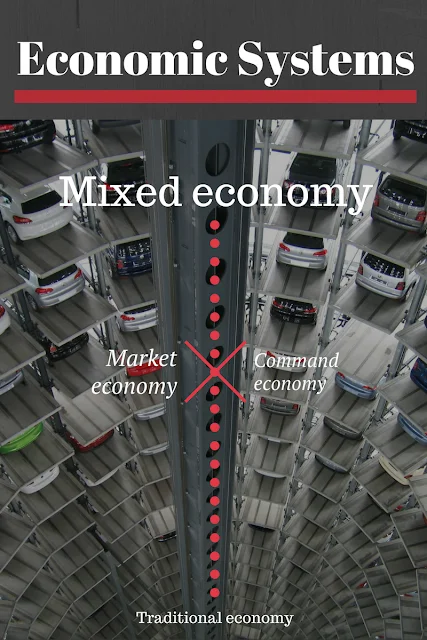
One caveat worth stating plainly: none of these are pure, unregulated markets. Every one is really a mixed economy with a dominant private sector — governments still enforce contracts, provide public goods and regulate. The difference between countries is where they sit on the spectrum, not whether the state is involved at all.
Key takeaways
- A market economy sets prices through supply and demand among private actors, not central planning.
- Its pillars are private property, competition, the price mechanism and the profit motive.
- Freer economies are far richer on average — $52,877 vs $6,968 GDP per capita (Fraser Institute, 2024).
- Real economies such as Singapore and Switzerland are market-dominated but still mixed.
Advantages and drawbacks of a market economy
Markets are efficient because competition and prices push resources to their most valued uses, and the profit motive rewards innovation and consumer choice. The trade-offs are real too: markets can produce wide inequality, under-supply public goods such as defence or clean air, and swing through booms and busts. That is why every modern market economy pairs private enterprise with some government correction.
Frequently asked questions
What is a market economy in simple terms?
A market economy is one where private individuals and businesses — not the government — own resources and decide what to make and sell, and prices are set by supply and demand. Singapore and Switzerland are leading examples.
What is the difference between a market economy and a command economy?
In a market economy, prices and private competition decide production. In a command economy, the government owns the means of production and a central authority sets output and prices. Most countries mix both, leaning one way or the other.
Is the United States a market economy?
The United States is a market-oriented mixed economy. Private markets drive most activity, but the government still regulates, taxes and provides public services. No large economy today is a pure, unregulated market.
Sources
- Heritage Foundation, 2025 Index of Economic Freedom — retrieved 2026-07-04 — heritage.org
- Fraser Institute, Economic Freedom of the World 2024 Annual Report — retrieved 2026-07-04 — fraserinstitute.org
- World Bank, Employment in services (% of total employment), 2023 — retrieved 2026-07-04 — data.worldbank.org
- Encyclopaedia Britannica, Price mechanism — retrieved 2026-07-04 — britannica.com
Last updated: August 2026


Leave a Reply