
Key Economic Insights: The economy of Puerto Rico generates an estimated GDP of $126.03 billion (National Accounts Tracked per capita) supporting a population of 3,203,295. Productive output is anchored by 49.1% services, 50.1% industry and manufacturing, and 0.8% agriculture and natural resource extraction. Key merchandise exports include Manufactured goods, mineral resources, and agricultural commodities, directed primarily toward Global and regional trade partners.
Puerto Rico, with a population of 3,203,295, is ranked 129th in population size, just behind Bosnia and Herzegovina. Located in the Caribbean, it covers a total area of 8,870 square kilometers, ranking 155th in size, just below Cyprus.
As of 2024, Puerto Rico’s economy is marked by a GDP of $126.03 billion, ranking among the larger economies globally. The GDP per capita for Puerto Rico in 2024 is approximately $39,343.70.
Despite facing challenges, Puerto Rico’s economy shows resilience and potential for growth in the coming years.
Puerto Rico Economic Structure & Sector Analysis
| Economic Dimension | Official Indicator (2024–2026) | Authoritative Source |
|---|---|---|
| GDP & Macro Output | Nominal GDP: $126.03 billion | Per Capita: National Accounts Tracked | World Bank WDI / IMF |
| Sector Breakdown | Services: 49.1% | Industry: 50.1% | Agriculture: 0.8% | World Bank National Accounts |
| Trade & Commodities | Top Exports: Manufactured goods, mineral resources, and agricultural commodities (Total: $10 billion) | UN Comtrade / OEC |
| Demographics & Labor | Population: 3,203,295 | Distributed workforce across formal & primary sectors | ILO / UN Population Division |
| Strategic Trade Corridors | Leading Trade Partners: Global and regional trade partners | World Bank WITS / IMF DOTS |
- Primary activities (agriculture): 0.8% of GDP.
- Secondary activities (industry): 50.1% of GDP.
- Tertiary activities (services): 49.1% of GDP.
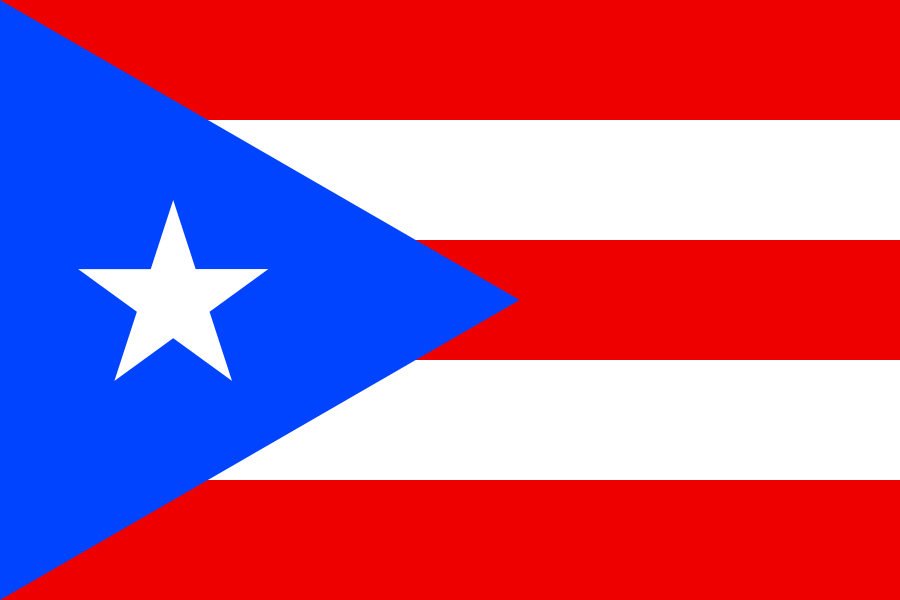
Primary Sector of Puerto Rico
With 19.04% of the land dedicated to agriculture, the country produces a diverse range of products including milk, plantains, bananas, chicken, tomatoes, mangoes/guavas, eggs, oranges, pumpkins/squash, and papayas.
Despite contributing only 0.8% to the GDP, agriculture plays a crucial role in sustaining local livelihoods and food security. The variety of crops and animal products highlights the sector’s significance, showcasing the country’s agricultural potential and cultural heritage.
The country boasts a diverse geological landscape, enabling the availability of natural resources like copper, nickel, and potential for oil extraction both onshore and offshore. These resources play a vital role in the economy, supporting industries and driving economic growth.
Secondary Sector of Puerto Rico
In Puerto Rico, the main industrial products include pharmaceuticals, electronics, apparel, and food products. These goods are manufactured for both domestic consumption and export, contributing significantly to the country’s economy.
Manufactures in Puerto Rico’s total exports in 2023 are not as significant, with a low percentage indicating a reliance on other sectors for economic growth and stability.
Tertiary sector of Puerto Rico
This sector includes intangible goods like advice, attention, and expertise, catering to both consumer and business-to-business needs. Key tertiary activities in Puerto Rico include healthcare and medical care, education and training, banking and finance, communication and information exchange, tourism and hospitality, and transportation and logistics. These services play a crucial role in the economy, contributing to the overall development and well-being of the country.
Specifically, Puerto Rico’s economy heavily relies on tourism, contributing significantly to its GDP. With 4,931,000 annual arrivals, surpassing its population of 1.5305 tourists per capita, popular destinations like Old San Juan and the Flamenco Beach in Culebra attract travelers from around the world, driving the island’s thriving tourism industry.
Another example of tertiary economic activity is the mobile cellular sector, which boasts nearly 3.9 million subscriptions, supporting technological growth by enhancing communication, fostering innovation, and facilitating e-commerce.
Biggest company in Puerto Rico
Which is the biggest company in Puerto Rico? The largest company is Popular, Inc. (parent of Banco Popular de Puerto Rico), with a market capitalization of roughly $10 billion USD as of 2026 and total revenue of about $4.3 billion in 2024. It operates in the banking and financial services industry, which is part of the tertiary economic sector. Popular, Inc. was founded in 1893 and is the largest bank and largest publicly traded company based in Puerto Rico.
International Trade of Puerto Rico
Import Activities of Puerto Rico

Puerto Rico’s high import activities, accounting for 45.41% of GDP, signify its reliance on foreign goods for economic growth and development.
Puerto Rico’s key imports include nitrogen compounds, sulfur compounds, refined petroleum, medical cultures/vaccines, and cars. Its main import partners in 2019 were the United States (49.9%), Ireland (12.6%), Singapore (5.1%), South Korea (4.9%), and Switzerland (4.0%). These imports play a crucial role in sustaining various sectors of the country’s economy.
Exports Activities of Puerto Rico

Puerto Rico’s total exports were approximately $59.8 billion, representing about 47.4% of its GDP (relative to 2024 GDP). With export activities playing a crucial role, this high percentage underscores their significant contribution to the country’s economic growth and stability.
Puerto Rico’s export activities in 2019 included packaged medicines, medical cultures/vaccines, hormones, orthopedic and medical appliances, and sulfur compounds. The country’s top export partners in 2019 were the United States (75.7%), the Netherlands (4.2%), Italy (2.9%), Belgium (2.8%), and Spain (1.8%).
Puerto Rico economy challenges in 2024
In 2024, Puerto Rico continues to face economic challenges due to the impact of COVID-19 and hurricanes. The labor force and job growth are declining, exacerbating the high poverty rates. The country heavily relies on imported energy, further straining its economy. The capital-based industries and tourism sector struggle to recover, highlighting the need for sustainable solutions to revive the economy.
Sources
Last updated: August 2026



Leave a Reply