
Key Economic Insights: The economy of Uganda generates an estimated GDP of $53.65 billion ($1,073 per capita) supporting a population of 45,905,417. Productive output is anchored by Tracked by World Bank services, Tracked by World Bank industry and manufacturing, and Tracked by World Bank agriculture and natural resource extraction. Key merchandise exports include Manufactured goods, mineral resources, and agricultural commodities, directed primarily toward Global and regional trade partners.
As of 2024, Uganda’s GDP stands at approximately $53.65 billion (World Bank, current US$), placing it among the larger economies in East Africa. In terms of GDP per capita, Uganda recorded about $1,073 in 2024, reflecting steady growth from prior years as the economy expands.
Uganda’s economy is showing steady growth, with various sectors contributing to its development. The country continues to focus on improving infrastructure, promoting agriculture, and attracting foreign investment to further boost its economic standing on the global stage.
Uganda Economic Structure & Sector Analysis
| Economic Dimension | Official Indicator (2024–2026) | Authoritative Source |
|---|---|---|
| GDP & Macro Output | Nominal GDP: $53.65 billion | Per Capita: $1,073 | World Bank WDI / IMF |
| Sector Breakdown | Services: Tracked by World Bank | Industry: Tracked by World Bank | Agriculture: Tracked by World Bank | World Bank National Accounts |
| Trade & Commodities | Top Exports: Manufactured goods, mineral resources, and agricultural commodities (Total: $1.12 billion) | UN Comtrade / OEC |
| Demographics & Labor | Population: 45,905,417 | Distributed workforce across formal & primary sectors | ILO / UN Population Division |
| Strategic Trade Corridors | Leading Trade Partners: Global and regional trade partners | World Bank WITS / IMF DOTS |
- Primary activities (agriculture, forestry, fishing): about 24.6% of GDP (FY2023/24).
- Secondary activities (industry): about 25.2% of GDP (FY2023/24).
- Tertiary activities (services): about 42.8% of GDP (FY2023/24).

Primary Sector of Uganda
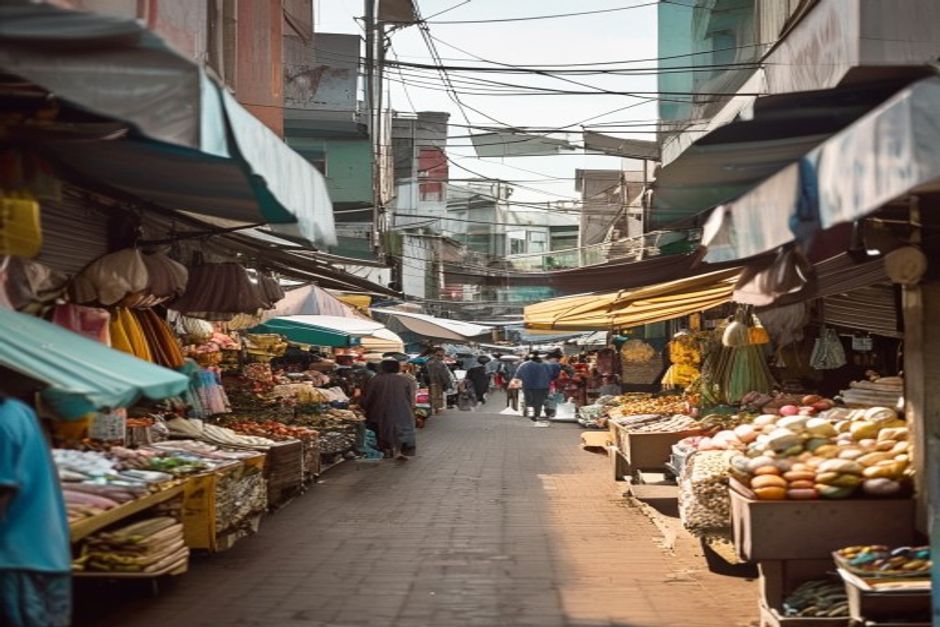
With 71.89% of the land dedicated to agriculture, the country produces a variety of crops like plantains, sugarcane, maize, cassava, and more. Animal products such as milk also play a significant role.
As of 2024, despite agriculture contributing about 24.6% to the GDP, it remains a crucial sector for food security and employment. The diverse range of agricultural products highlights the sector’s importance in sustaining Uganda’s economy and livelihoods.
The country’s geological diversity contributes to a rich array of natural resources. Copper, cobalt, gold, and limestone drive the economy, while hydropower is a key energy source. Abundant arable land supports agriculture, and salt reserves further boost the primary sector.Secondary Sector of Uganda
In Uganda, the main industrial products include sugar processing, brewing, cotton textiles, cement, and steel production. These industries play a crucial role in the country’s economy by adding value to raw materials and creating products for domestic consumption and export.In 2023, Uganda’s total exports were dominated by agriculture, minerals, and services, with manufactures accounting for a small percentage. This indicates that the country’s manufacturing sector may not play a significant role in its overall export economy.Tertiary sector of Uganda
Military Activities and Economic Sectors of Uganda
In Uganda, the primary sector helps by providing resources for military use. The secondary sector focuses on making military equipment. The tertiary sector includes services offered by the military, while the quaternary sector is about military research and development. Lastly, the quinary sector involves high-level decision-making and strategy for the military.
As of 2024, Uganda’s military expenditure was about $1.12 billion, which is roughly 1.8% of the country’s GDP. The active military force has around 45,000 personnel, which means there are 1.4 active military members for every 1,000 people in the country.
Biggest company in Uganda
Which is the biggest company in Uganda? Among the largest companies is MTN Uganda, the country’s leading telecommunications operator, which reported service revenue of about UGX 3.14 trillion (roughly $850 million) for the financial year ended December 2024. Listed on the Uganda Securities Exchange, it operates in the telecommunications industry, part of the Tertiary economic sector. MTN Uganda began operations in 1998 and serves over 20 million customers.International Trade of Uganda
Import Activities of Uganda
 Uganda’s import activities are of high importance, accounting for 22.48% of its GDP in 2023, totaling $1,024,503,675.89.Uganda’s key import activities include vaccines, medicine, plastic products, cars, motorcycles, and cycles. The country’s top import partners are China (23%), Kenya (15%), India (13%), UAE (7%), and Tanzania (6%).
Exports Activities of Uganda
 Uganda’s total exports in 2023 amounted to $5,478,099,263.94, with exports contributing 12.02% to its GDP. This indicates a medium level of importance, highlighting the country’s reliance on exports for economic growth and stability.Uganda’s export activities are diverse, with top partners being UAE, India, Hong Kong, Kenya, and Italy. Key export commodities include gold, coffee, fish, milk, and raw sugar.
Uganda economy challenges in 2024
Uganda faces economic challenges post-COVID-19, with lower oil prices impacting sector investments. Endemic corruption hampers progress despite natural resources. High female labor force participation is undervalued, hindering growth.Sources
- World Bank Data: Uganda
- IMF Data Mapper
- CIA World Factbook: Uganda
- Uganda Bureau of Statistics
- Heritage Foundation: All Country Scores
- Our World in Data: Human Development Index
- UN Comtrade Plus: Trade Flow
- SIPRI Military Expenditure Database
Last updated: August 2026


Leave a Reply