
Key Economic Insights: The economy of Djibouti generates an estimated GDP of $4.09 billion ($3,276 per capita) supporting a population of 1,120,849. Productive output is anchored by 81.98% services, 15.44% industry and manufacturing, and 2.58% agriculture and natural resource extraction. Key merchandise exports include palm oil, chlorides, seed oils, flax yarn, and cattle, directed primarily toward Global and regional trade partners.
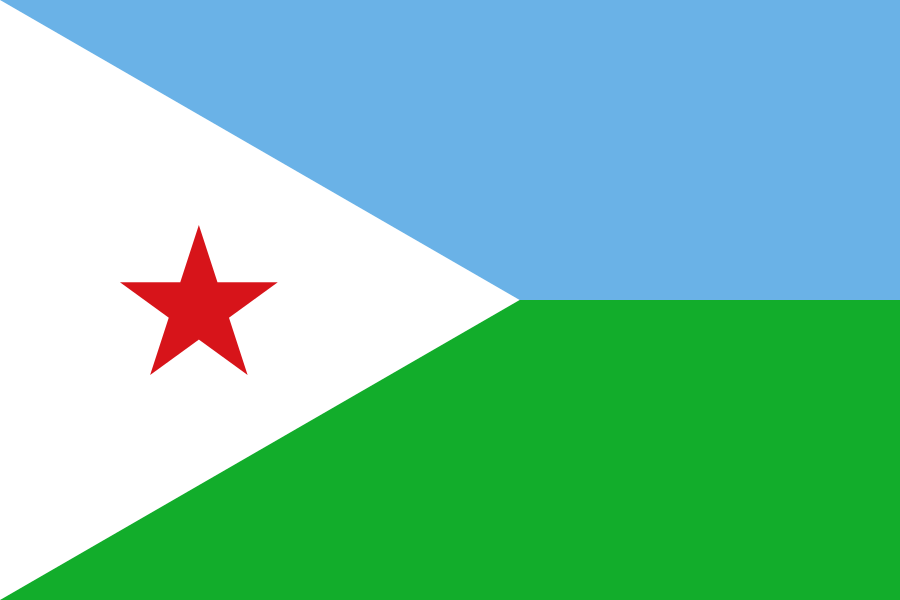
[Djibouti] is a country with a population of 1,120,849, ranking 152nd globally, just behind Eswatini. Located in the Horn of Africa, it covers 23,200 square kilometers, ranking 140th worldwide, slightly smaller than North Macedonia.
As of 2024, Djibouti’s GDP stood at approximately 4.09 billion USD (up from about 3.52 billion USD in 2022), reflecting steady growth driven by its ports and transit trade. In terms of GDP per capita, Djibouti stands at approximately 3,276 USD (2024), placing it among the lower-middle-income economies.
Djibouti’s economy is steadily growing, with a focus on sectors such as transportation, logistics, and trade due to its strategic location at the southern entrance to the Red Sea.
Djibouti Economic Structure & Sector Analysis
| Economic Dimension | Official Indicator (2024–2026) | Authoritative Source |
|---|---|---|
| GDP & Macro Output | Nominal GDP: Official World Bank Data | Per Capita: $3,276 | World Bank WDI / IMF |
| Sector Breakdown | Services: 81.98% | Industry: 15.44% | Agriculture: 2.58% | World Bank National Accounts |
| Trade & Commodities | Top Exports: palm oil, chlorides, seed oils, flax yarn, and cattle (Total: Official UN Comtrade) | UN Comtrade / OEC |
| Demographics & Labor | Population: 1,120,849 | Distributed workforce across formal & primary sectors | ILO / UN Population Division |
| Strategic Trade Corridors | Leading Trade Partners: Global and regional trade partners | World Bank WITS / IMF DOTS |
- Primary activities: 2.58% of GDP (2024 est.).
- Secondary activities: 15.44% of GDP (2024 est.).
- Tertiary activities: 81.98% of GDP (2024 est.).
Primary Sector of Djibouti
With 73.51% of land dedicated to agriculture, the country produces a variety of crops and animal products such as vegetables, beans, milk, beef, camel milk, lemons/limes, goat meat, lamb/mutton, tomatoes, and beef offal.
Despite contributing only about 2.58% to the GDP (2024 est.), agriculture plays a crucial role in Djibouti’s economy by providing food security and employment opportunities. The diverse range of agricultural products showcases the sector’s importance in sustaining the country’s agricultural industry.
Djibouti’s diverse geology provides a range of natural resources, including potential geothermal power, gold, clay, granite, limestone, marble, salt, diatomite, gypsum, pumice, and petroleum. These resources play a crucial role in the country’s economy, contributing to sectors such as energy, construction, and mining.
Secondary Sector of Djibouti
These industries take raw materials from primary activities and manufacture new goods for domestic sale or export. In Djibouti, the main industrial products include construction materials, agricultural processing products, and shipping services.
Manufactures make up a small percentage of Djibouti’s total exports in 2023, indicating a reliance on other sectors for economic growth and development.
Tertiary sector of Djibouti
The tertiary sector consists of intangible services that enhance productivity and meet needs. In Djibouti, key tertiary activities include healthcare, education, banking, communication, tourism, and transportation.
In particular, Djibouti’s tourism industry plays a pivotal role in its economy, accounting for a significant portion of its GDP. With annual tourist arrivals numbering around 123,000 in a population of around 1 million, popular destinations like Lake Assal and Moucha Island contribute greatly to this sector’s growth. The government actively promotes sustainable tourism to further bolster the economy.
Another example of tertiary economic activity is the mobile cellular economic sector, with approximately 519,000 subscriptions, supporting technological growth by enhancing communication and access to digital services across the population.
International Trade of Djibouti
Import Activities of Djibouti

Import activities are crucial for Djibouti, whose role as a re-export and transit hub for landlocked Ethiopia makes trade very large relative to its economy. Merchandise imports totaled roughly 5.3 billion USD in 2023, a figure inflated by goods that transit through Djibouti’s ports to neighboring countries.
Djibouti’s key import partners are China (38%), UAE (20%), India (10%), Morocco (6%), and Turkey (6%). The country imports refined petroleum, palm oil, fertilizers, cars, and raw sugar, supporting its economy and infrastructure development.
Exports Activities of Djibouti

Djibouti’s merchandise exports (including re-exports through its ports) totaled roughly 4.8 billion USD in 2023, the bulk of which is transit trade destined for Ethiopia rather than goods produced domestically. Domestically produced exports remain modest.
Djibouti primarily exports palm oil, chlorides, seed oils, flax yarn, and cattle. Its main export partners are Ethiopia (61%), China (17%), India (7%), Jordan (2%), and Central African Republic (1%).
Djibouti economy challenges in 2024
In 2024, Djibouti faces challenges in balancing its food import-dependent economy with growing trade relations with Ethiopia and China. The country’s resilience to COVID-19 disruptions is tested as it strives to invest in infrastructure while maintaining its status as a key re-exporter in the region.
Sources
Last updated: August 2026




Leave a Reply