
Key Economic Insights: The economy of French Polynesia generates an estimated GDP of $6.32 billion ($22,440 per capita) supporting a population of 281,807. Productive output is anchored by 84.5% services, 13% industry and manufacturing, and 2.5% agriculture and natural resource extraction. Key merchandise exports include pearls, fish, aircraft parts, coconut oil, and electrical power accessories, directed primarily toward France being the largest contributor at 30%.
French Polynesia, with a population of 281,807 (as of 2024), is ranked 181st in the world. Located in the South Pacific Ocean, it covers a total area of 3,471 square kilometers, ranking 159th globally, below Cabo Verde.
As of 2024, French Polynesia’s economy is relatively stable, with a GDP of approximately $6.32 billion. In terms of GDP per capita, French Polynesia has an average of about $22,440 (as of 2024), one of the highest in the Pacific region. (Source: World Bank)
French Polynesia’s economy shows potential for growth and development in the coming years.
French Polynesia Economic Structure & Sector Analysis
| Economic Dimension | Official Indicator (2024–2026) | Authoritative Source |
|---|---|---|
| GDP & Macro Output | Nominal GDP: $6.32 billion | Per Capita: $22,440 | World Bank WDI / IMF |
| Sector Breakdown | Services: 84.5% | Industry: 13% | Agriculture: 2.5% | World Bank National Accounts |
| Trade & Commodities | Top Exports: pearls, fish, aircraft parts, coconut oil, and electrical power accessories (Total: $2.3 billion) | UN Comtrade / OEC |
| Demographics & Labor | Population: 281,807 | Distributed workforce across formal & primary sectors | ILO / UN Population Division |
| Strategic Trade Corridors | Leading Trade Partners: France being the largest contributor at 30% | World Bank WITS / IMF DOTS |
- Primary activities: 2.5% of GDP.
- Secondary activities: 13% of GDP.
- Tertiary activities: 84.5% of GDP.
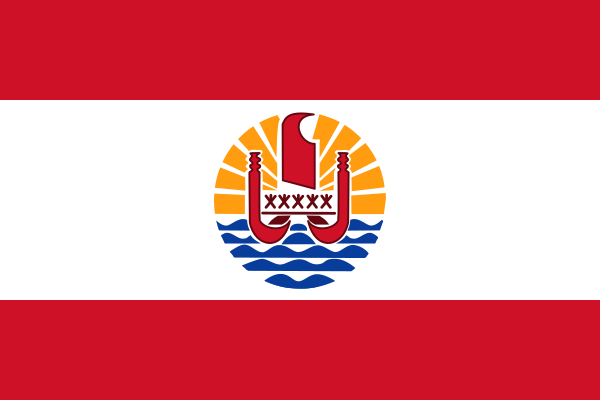
Primary Sector of French Polynesia
The primary sector in French Polynesia, with its tropical climate and diverse natural resources, mainly focuses on agricultural activities. Covering 13.97% of the land, the country’s main agricultural products include coconuts, fruits, root vegetables, pineapples, eggs, cassava, sugarcane, tropical fruits, watermelons, and tomatoes.
Despite contributing 2.5% to the GDP, agriculture plays a vital role in the country’s economy by providing a variety of crops and animal products essential for local consumption and export. The sector’s significance lies in the diversity of products it offers, showcasing the rich agricultural potential of French Polynesia.
The geological diversity of French Polynesia, from lush forests to abundant marine life, provides a rich array of natural resources. Timber, fish, cobalt, and hydropower are key assets driving the economy, supporting industries like forestry, fishing, mining, and energy production.
Secondary Sector of French Polynesia
In French Polynesia, the main industrial products include agricultural processing, handicrafts, and phosphates.
Manufactures play a crucial role in French Polynesia’s total exports, accounting for 68.27% in 2023. This highlights the significance of the manufacturing sector in driving the country’s economic growth and trade activities.
Tertiary sector of French Polynesia
Key activities include healthcare, education, banking, tourism, transportation, and telecommunications. These services contribute significantly to the economy by offering intangible goods such as knowledge, advice, and experiences.
Among these, French Polynesia’s economy heavily relies on tourism, contributing significantly to its GDP. With roughly 236,000 international visitor arrivals (as of 2023, recovering toward the 2019 pre-pandemic peak), the industry remains the economy’s mainstay. Popular destinations include the idyllic Bora Bora, renowned for its overwater bungalows, and the volcanic Moorea Island, boasting stunning landscapes and marine life.
Another example of tertiary economic activity is the mobile cellular sector, with approximately 328,000 subscriptions, supporting technological growth. This connectivity enhances communication, fostering innovation and digital services.
International Trade of French Polynesia
Import Activities of French Polynesia

Import activities in French Polynesia are crucial, accounting for about 36% of GDP, with total imports in 2023 reaching roughly $2.3 billion.
French Polynesia imports a variety of goods, including refined petroleum, cars, packaged medicine, beef, and plastic products. Its main import partners are France, China, the US, South Korea, and New Zealand, with France being the largest contributor at 30%.
Exports Activities of French Polynesia

French Polynesia’s total merchandise exports in 2023 amounted to approximately $244 million. With exports accounting for about 3.8% of its GDP, merchandise trade plays a modest role relative to the tourism-driven services economy. (Source: World Bank WITS)
French Polynesia primarily exports pearls, fish, aircraft parts, coconut oil, and electrical power accessories. Its main export partners are France, the US, Hong Kong, Japan, and the Netherlands, with each accounting for a significant portion of its export trade.
French Polynesia economy challenges in 2024
French Polynesia faces economic challenges in 2024 due to its small, tourism-based economy heavily reliant on French financing. Despite lower EU import duties and resilience from COVID-19, the country’s oil-dependent infrastructure poses sustainability concerns as a Pacific Islands Forum member.
Sources
- World Bank: French Polynesia
- CIA World Factbook: French Polynesia
- IMF: French Polynesia
- World Bank WITS: French Polynesia Trade
- ISPF (Institut de la Statistique de la Polynésie française)
Last updated: August 2026




Leave a Reply