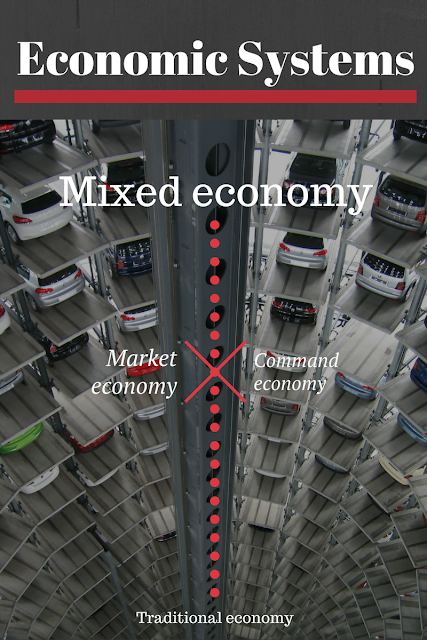
An economic system is the way a society organises the production and distribution of goods and services. There are four main types: traditional, command, market and mixed. They differ in who owns resources and who decides what to produce. Almost every country today runs a mixed economy.
What is an economic system?
An economic system is how a country answers three basic questions: what to produce, how to produce it, and for whom. The answer depends on who owns the means of production and how decisions are made — by custom, by the state, by the market, or by a blend of all three. Economists group these arrangements into four main types.
| System | Who decides | Ownership | Examples |
|---|---|---|---|
| Traditional | Custom and habit | Communal / subsistence | Rural and Indigenous communities |
| Command | Central government | State-owned | North Korea, Cuba |
| Market | Prices, supply and demand | Private | Singapore, Switzerland |
| Mixed | Markets plus government | Private and public | United States, France, most nations |
The four types of economic system
Traditional economy. The oldest system, based on custom, subsistence farming, herding and barter. Roles pass down through generations, and there is little surplus or growth.
Command economy. The state owns the means of production and a central authority sets output, prices and distribution. It can mobilise resources quickly but tends to cause shortages without price signals.
Market economy. Private individuals and firms own resources, and prices set by supply and demand decide what gets produced. Competition and the profit motive drive efficiency and innovation, but can widen inequality.
Mixed economy. The most common system today. Private markets lead, while the government regulates, provides public services and redistributes income. Countries differ only in how large the state’s role is.
Which system do countries actually use?
In practice, almost every modern country is a mixed economy — the debate is only about where it sits between free markets and state control. Pure command economies are rare (North Korea is the clearest), and pure market or traditional economies barely exist. The system a country chooses shapes every economic activity within it, from how markets are organised to how wealth is shared. You can see how this plays out country by country in our economic-system profiles, such as Mexico’s economy.
Key takeaways
- An economic system decides what a society produces, how, and for whom.
- The four types are traditional, command, market and mixed.
- They differ in who owns resources and who makes decisions.
- Almost every country today runs a mixed economy.
Frequently asked questions
What are the four types of economic system?
Traditional (based on custom and subsistence), command (state-controlled), market (private and price-driven), and mixed (a blend of market and government). Mixed economies are by far the most common today.
Which economic system is most common?
The mixed economy. Nearly every country combines private markets with some government role — regulation, public services and redistribution — differing only in how large the state’s part is.
How do economic systems relate to capitalism and socialism?
Capitalism is closest to a market economy (private ownership, free markets), while socialism leans toward a command economy (collective or state ownership). Most real countries mix elements of both in a mixed economy.
Sources
- Encyclopaedia Britannica, Economic system — retrieved 2026-07-05 — britannica.com
- Heritage Foundation, Index of Economic Freedom — retrieved 2026-07-05 — heritage.org
Last updated: July 4, 2026


Leave a Reply